I’m probably going to piss off a few EMS educators right out of the gate.
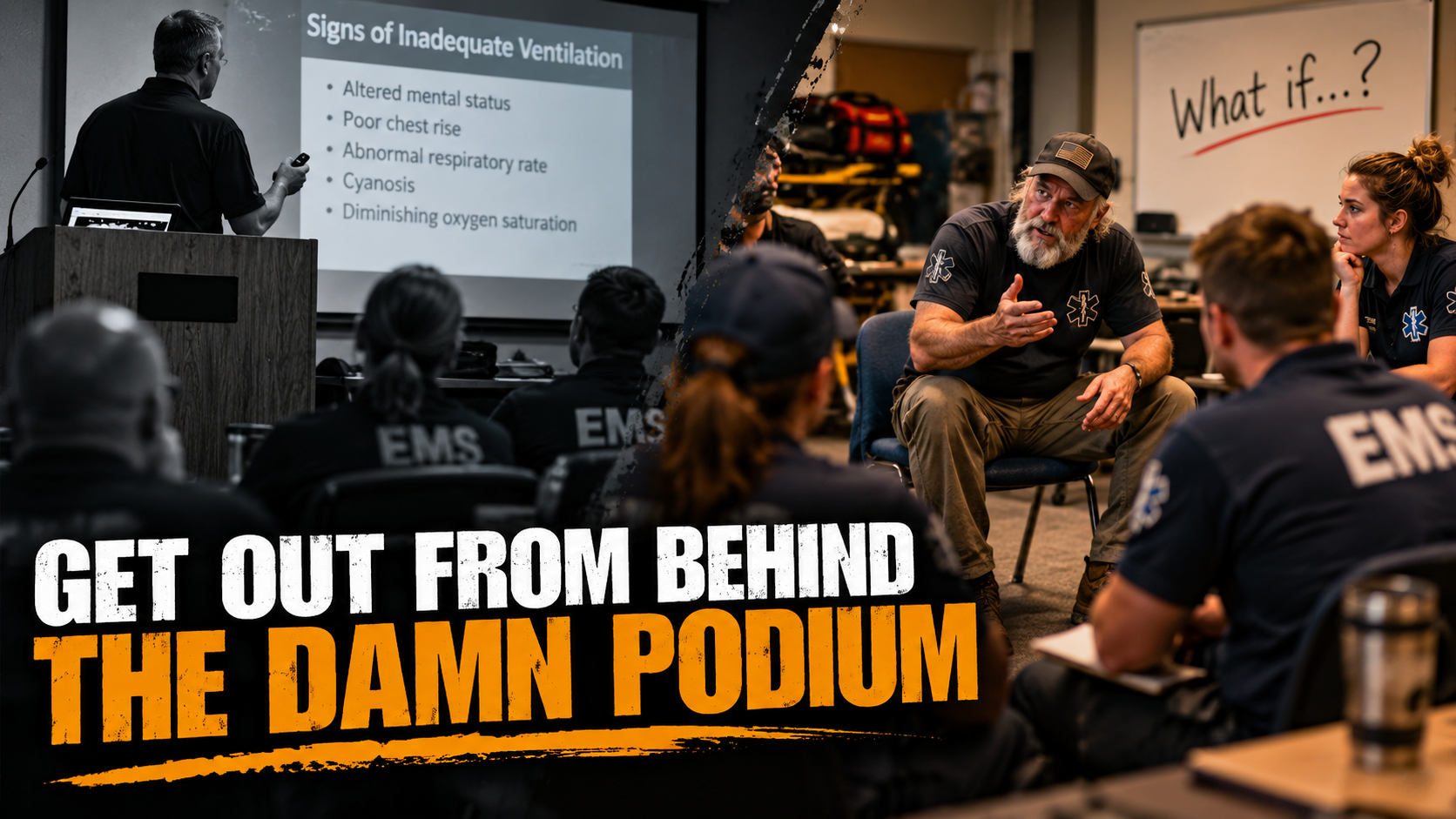
If you’re standing behind a podium with a clicker in your hand, reading PowerPoint slides to a room full of grown-ass adults…
you’ve already lost.
There. I said it.
Now, before somebody starts clutching their instructional-design pearls, let me clarify something.
I’m not saying lectures are dead.
I’m not saying PowerPoint is evil.
And I’m not saying we need to flip every classroom, divide everybody into breakout groups, play EMS Jeopardy, arrange the chairs according to somebody’s learning taxonomy, or turn ACLS into Family Feud.
All of those things have their place. Some of them are damn good teaching methods.
But none of them automatically makes you a good teacher. And standing behind a podium doesn’t automatically make you one either.
Your Students Can Read
This may come as a shock, but most of the people sitting in an EMS classroom possess at least a functional ability to read words on a screen.
So if your slide says:
Signs of inadequate ventilation
• Altered mental status
• Poor chest rise
• Abnormal respiratory rate
• Cyanosis
• Diminishing oxygen saturation
…please, for the love of all things holy, don’t turn around and read those five bullet points to them.
They can see them.
Hell, some of them probably read the entire slide while you were still saying, “Okay, on our next slide…”
That slide isn’t your lesson.
You are.
The slide is there to keep you from wandering off into a 25-minute war story about something that happened on an ambulance during the Clinton administration.
And yes, I’m talking to myself, too.
That’s why I keep the damn slide behind me.
Every now and then I glance over my shoulder and think:
“Oh yeah. That’s what the hell we were talking about.”
Pull Up a Chair
My classroom probably looks a little strange compared with what some instructors are accustomed to.
I don’t particularly like standing at the front of the room.
I sit.
Usually somewhere around the middle of the class, toward the head of the group.
Why?
Because I want to see faces. I want eye contact. I want conversation. I want somebody to challenge something I just said.
And I want somebody to ask:
“Okay, but what if…?”
Because “what if” is where EMS actually lives.
The textbook gives you the clean version. The protocol gives you the approved version. PowerPoint gives you the bullet-point version.
Then at 0300 you walk into somebody’s bathroom and discover none of those sons of bitches bothered to read the textbook.
That’s EMS.
So instead of reading that ventilation slide, let’s talk about it.
“Which one of those findings bothers you the most?”
Somebody says cyanosis.
Why?
Somebody else says altered mental status.
Why?
Then somebody in the back says:
“I’d be worried if their respiratory rate started dropping.”
Now we’re cooking.
Why?
Because maybe that patient isn’t getting better. Maybe they’re getting tired. Maybe that respiratory rate dropping from 38 to 24 isn’t quite the improvement somebody thinks it is.
And now we’re talking about a patient instead of a PowerPoint.
Funny Thing — We Already Teach This
Here’s the part that gets me.
We already teach EMS providers not to interview patients like robots.
Don’t stand six feet away staring at your clipboard. Get on the patient’s level. Make eye contact. Ask a question. Listen to the answer.
Then let that answer help determine the next question. Watch the patient’s face. Pay attention to hesitation. Notice when something doesn’t quite fit.
In other words:
Have a damn conversation.
So explain something to me.
Why do we teach providers to communicate with patients that way…
…and then teach those providers by standing behind a wooden box forty feet away clicking through 87 slides?
That’s a little…
Well, you know.
The Podium Isn’t the Problem
Before somebody sends me an angry message defending podiums, the furniture isn’t actually the problem.
The problem is distance.
Distance between instructor and student. Distance between information and application. Distance between knowing the answer and understanding why the answer matters.
A great instructor can stand behind a podium and teach the hell out of a class.
A terrible instructor can sit in a circle, flip the classroom, gamify the lesson, use breakout groups and employ every educational buzzword invented since Bloom started stacking boxes—and still bore everyone into a coma.
Methods are tools. That’s it.
A hammer doesn’t make you a carpenter.
And owning a clicker sure as hell doesn’t make you an educator.
Sometimes the Best Teaching Tool Is “Why?”
One of my favorite classroom tools doesn’t require batteries. It doesn’t need Wi-Fi. There isn’t a subscription fee.
It’s one word.
Why?
“I’d give oxygen.”
Why?
“I’d start an IV.”
Why?
“I’d put them on the monitor.”
Why?
“I’d transport emergent.”
Why?
I’m not asking because I’m trying to catch somebody being wrong. I’m asking because I want to know what’s happening between their ears.
Sometimes they have a damn good reason. Sometimes they’re repeating something somebody taught them ten years ago.
Sometimes the answer is essentially:
“Because that’s how we’ve always done it.”
Wonderful.
Now we have something worth talking about.
The Classroom Should Look a Little Like the Street
EMS education shouldn’t just transfer information.
It should model behavior.
If I expect you to sit beside Grandma and actually listen to her, I ought to demonstrate what listening looks like.
If I expect you to ask follow-up questions, I should ask follow-up questions.
If I expect you to think critically, I probably shouldn’t spend four hours telling you exactly what to think.
If I want you comfortable saying, “I don’t know,” then my classroom better be a place where those three words don’t get you publicly crucified.
Because I’d much rather hear:
“I don’t know.”
than:
“I didn’t want to look stupid, so I just guessed.”
One creates an opportunity to teach.
The other eventually creates an opportunity to explain yourself to QA.
Or worse.
And About Those War Stories…
There’s a place for them. Absolutely.
Thirty-two years on an ambulance taught me things that weren’t printed in any textbook I’ve ever owned. Those experiences have value.
But experience can also become instructor vanity if we’re not careful.
The students didn’t come to hear The Greatest Hits of Old Grumpy Paramedic, Volume IV.
A story belongs in the lesson when it illuminates the lesson. When it makes something real. When it demonstrates a mistake. When it gives context.
When it makes somebody sitting there think:
“Oh shit. I can see how that happens.”
Then tell it.
If the only reason you’re telling the story is because you were awesome in it?
Save that shit for the bar.
Find Your Own Damn Chair
Now here’s the part I don’t want lost in all this.
This is how I teach.
It’s my classroom style. It’s what I’ve developed over the years, and it’s what feels natural to me.
I’m not handing you another educational doctrine and telling you to go forth and arrange your classroom exactly like mine.
Please don’t.
Maybe you’re phenomenal behind a podium. Maybe you teach standing in the middle of the room. Maybe you live for simulation. Maybe your students learn best when you give them a problem, get the hell out of their way, and let them work through it.
Good.
Find your style.
More importantly, find the style that lets you connect with the people you’re teaching.
Borrow what works. Throw away what doesn’t. Change it when it stops working.
And don’t adopt some new teaching method just because somebody put a catchy name on it and presented it at a conference.
Your students will figure out pretty damn quickly whether you’re teaching them or performing at them.
Get Out From Behind the Damn Podium
Maybe I’m old-fashioned.
Or maybe there’s an eff’ing educational methodology with a six-syllable name for exactly what I’m doing and I just never bothered to learn it.
I don’t know.
I just know what works for me.
I sit down. I look people in the eye. I put enough information on the screen to give us somewhere to go.
And then…
we talk.
Sometimes we wander. Sometimes somebody asks a question that takes the entire lesson somewhere I hadn’t planned.
Sometimes a student says something that makes me reconsider how I’ve been looking at something.
Good.
That’s education.
Because my job isn’t to demonstrate how much I know. My job isn’t to finish 87 slides before lunch. And it damn sure isn’t to hear myself talk.
My job is to help the person sitting across from me become a better clinician than they were when they walked through the door.
Eventually that person is going to sit beside somebody’s mother. Somebody’s husband. Somebody’s kid.
There won’t be a podium. There won’t be a PowerPoint. And there sure as hell won’t be a clicker.
There will just be a patient looking them in the eye and expecting them to know what to do.
Maybe the best way to prepare them for that moment…
is to look them in the eye while we’re teaching them.
Now put down the damn clicker.
Or don’t.
Find what works for you.
Just make damn sure it works for the people sitting on the other side of the room.
For My Fellow Instructors
I mentioned several teaching methods in this article, and I don’t want my smart-ass comments about them to be mistaken for dismissing them.
Quite the opposite.
Flipped classrooms, active learning, case-based and problem-based learning, team learning, simulation, breakout discussions, and even a good old-fashioned lecture can all be useful tools.
Learn them. Try them. Steal the good parts. Figure out what works for you and, more importantly, what works for your students.
- Teaching Strategies & Active Learning — Yale Poorvu Center for Teaching and Learning: discussion, active learning, collaborative learning, effective lecturing, case-based learning and other approaches. Explore Yale’s teaching strategies resources.
- Case-Based & Problem-Based Learning — Yale Poorvu Center: using real-world scenarios and problems to move learners from remembering information toward applying it. Explore case-based and problem-based learning.
- Healthcare Simulation Standards of Best Practice — INACSL: simulation design, facilitation, prebriefing, debriefing, objectives, evaluation and more. Explore the INACSL standards.
I’m not presenting any of those as the way to teach.
Hell, I’m not presenting my way as the way to teach.
I’m telling you what works in my classroom.
Find what works in yours.
And if your students are engaged, thinking, asking questions, challenging assumptions and leaving your classroom better prepared to take care of the human being on the other end of the stretcher?
You’re probably doing something right.
About This Article
This article reflects my personal experience and teaching philosophy developed over a career in EMS and now as an EMS educator. The ideas, opinions and attitudes expressed here are solely my own and do not represent those of any current or former employer.
AI served as an editor, helping me organize and polish my own words and ideas. The lived experience, opinions, accountability, sass, grit and attitude are all mine.