
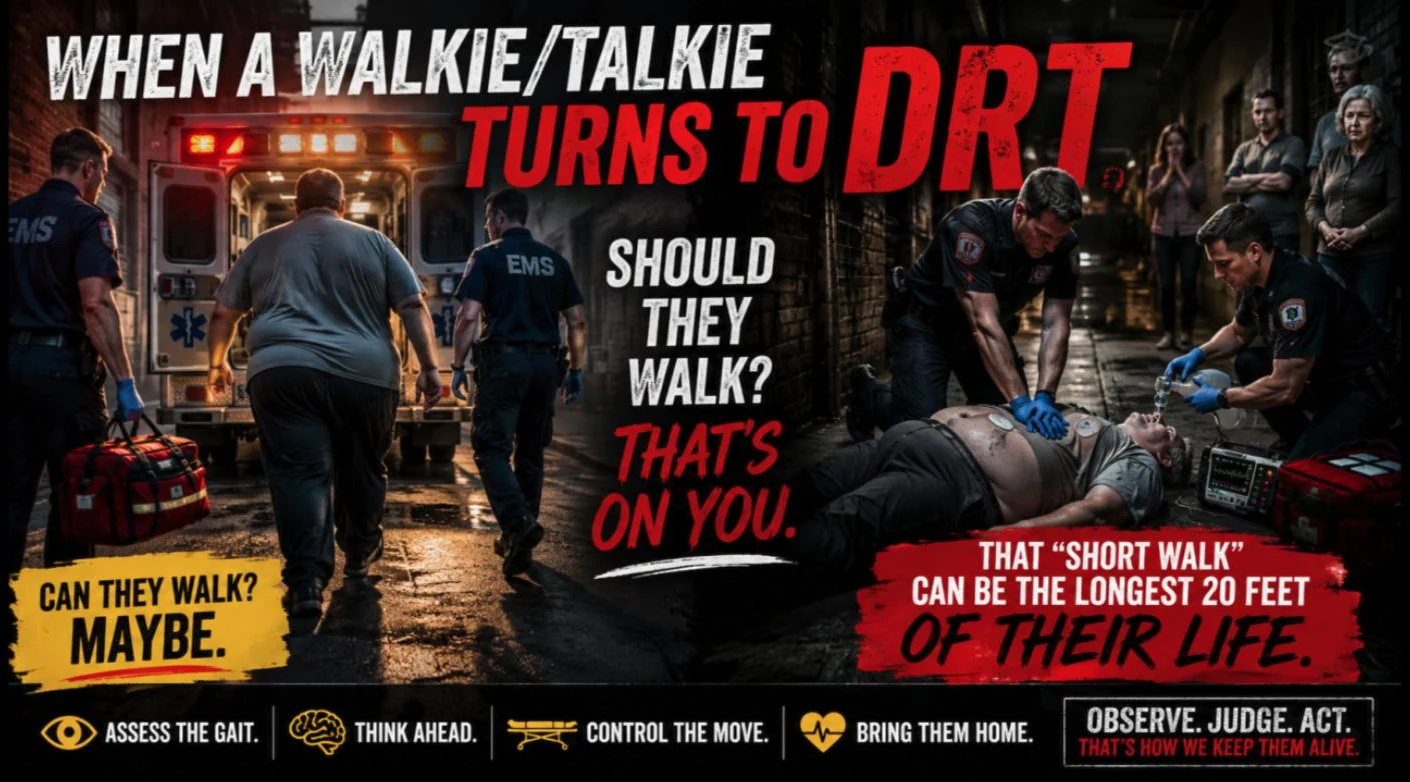
Now let’s take a step back… (Yeah, I said it.)
One of the hardest lessons new EMTs learn is this:
Just because a patient can walk does not mean their ass needs to be walking.
And the streets will absolutely teach you the difference — usually at the worst possible moment.
Especially at 0300. Three flights up. Sweating through your uniform shirt. Fire’s nowhere to be found. Your partner’s already sighing. And dispatch is asking if you’re clear yet.
That’s when lazy medicine starts whispering sweet nothings in your ear:
“They walked to the couch.” “They can make it to the stretcher.” “They’re fine to walk to the truck.”
Maybe.
And maybe you’re about to watch meemaw turn into a full arrest halfway down the apartment breezeway.
Walking Is Work
Here’s what new providers forget:
Walking is a stress test.
The second a patient starts ambulating, you increase oxygen demand, cardiac workload, respiratory effort, balance demands, and overall metabolic stress.
That “little walk” to the ambulance?
Sometimes that’s the exact moment the body runs out of reserve and says:
“Welp… I’m done.”
Patients compensate amazingly well sitting still.
Movement exposes weakness fast.
That’s why seasoned medics get twitchy about walking chest pain patients, respiratory calls, dizzy patients, generalized weakness, stroke symptoms, syncopal episodes, GI bleeds, bariatric patients, and anybody who already looks like they’re breathing through a screen door.
If walking twenty feet looks like it costs your patient their mortgage payment and retirement account…
STOP WALKING THEM.
“But They Said They Were Fine…”
Cool.
Patients also say:
“I don’t want to be a bother.” “I’m okay.” “I just got overheated.” “I don’t need all that.”
Meanwhile they’re gray, sweaty, grabbing furniture like they’re in a damn obstacle course, and breathing like an asthmatic bulldog climbing stairs.
Patients lie.
Not maliciously. Not intentionally.
Sometimes out of pride. Sometimes embarrassment. Sometimes fear. Sometimes because they genuinely don’t realize how sick they are.
Your job is not to win Employee of the Month for Fastest Stair Chair Avoidance.
Your job is keeping them alive long enough to complain about your cot straps later.
Let’s Talk Bariatrics
Alright. Let’s address the elephant in the room. Sometimes literally.
Yes, bariatric movement is hard.
It’s exhausting. It takes planning. It takes manpower. It’ll make you rethink every biscuit and Monster Energy drink you ever consumed.
But hear me clearly:
Would you rather struggle moving a bariatric patient safely to the cot…
…or perform CPR in a cramped hallway because they collapsed trying to walk to the medic unit?
Because those are very real choices.
New providers often confuse convenience with patient care.
Veteran providers understand: controlled movement beats uncontrolled collapse every single time.
Think Three Steps Ahead
Experienced medics constantly play the “what if” game.
If this patient collapses: Can I protect the airway? Can we get them out now? Is there room to work a code? How far are we from the cot? How exhausted are they already? What happens if they hit the floor?
That’s not paranoia.
That’s scene management.
That’s experience.
That’s the difference between reacting to disasters and preventing them.
Final Thoughts From the Bench Seat
One of the clearest signs of a seasoned provider is knowing when to slow the whole damn scene down.
Not every patient needs to walk.
And just because the patient says:
“I can make it…”
doesn’t mean you should let them try.
The stretcher exists for a reason.
Use it before the patient introduces themselves to the floor in front of God, family members, and half the apartment complex.