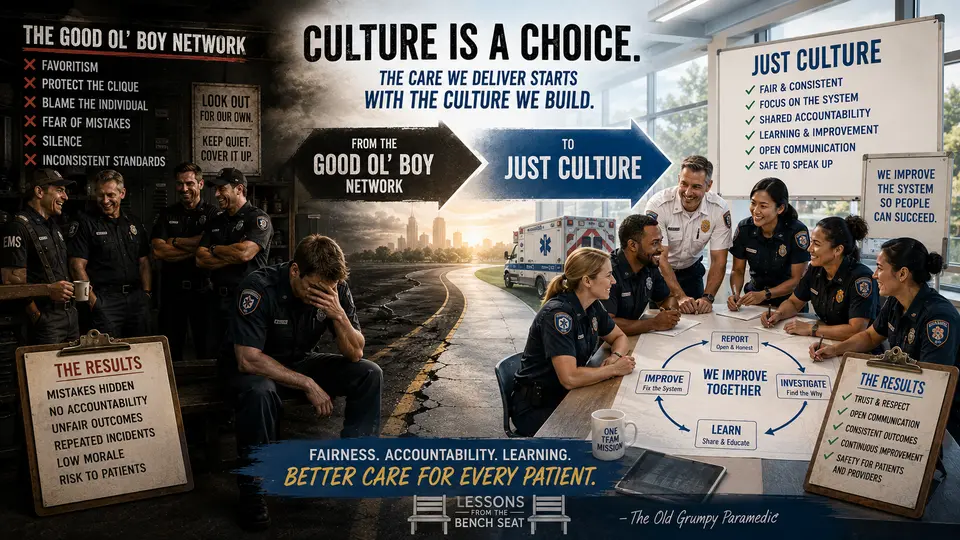
The Good Ol’ Boy Network
Let’s not romanticize the “good old days.”
Some of them were pretty damn good.
You had mentors who would give you the shirt off their back.
Partners who would crawl through fire beside you.
Chiefs who knew every employee’s spouse and kids by name.
There was loyalty.
There was pride.
There was family.
But there was another side of that coin.
If you belonged to the clique...
Life was good.
If you didn’t...
Good luck.
The rules weren’t always the same for everyone.
One medic could back an ambulance into a pole and somehow it became...
“Well... accidents happen.”
Another provider made the exact same mistake...
Now they’re sitting in the chief’s office explaining why they still deserved a job.
One employee’s chart “accidentally” disappeared.
Another employee’s documentation mistake became the topic of every kitchen table conversation for the next month.
The difference wasn’t the mistake.
The difference was who made it.
That’s not accountability.
That’s favoritism.
That’s the Good Ol’ Boy Network.
And whether we want to admit it or not...
EMS had plenty of it.
So Along Came Just Culture...
The idea behind Just Culture is actually pretty simple.
Before we decide what to do about the employee...
Let’s first understand what happened.
Was the provider properly trained?
Did the equipment contribute?
Was the policy confusing?
Were they set up to fail?
Was this an honest mistake?
Those are exactly the questions good leaders should ask.
Because not every error deserves punishment.
Sometimes the system deserves the blame.
I’ve said it for years during CQI reviews...
Sometimes that’s absolutely true.
If we’ve been teaching people the wrong process...
Leadership owns part of that failure.
But Here’s Where Old Grumpy Gets... Well... Grumpy.
Somewhere along the way...
Some people started confusing Just Culture with No Accountability.
Those aren’t the same thing.
Not even close.
If a brand-new EMT misses a documentation requirement because nobody ever taught them...
That’s a training issue.
If the electronic chart is confusing...
That’s a system issue.
If communication broke down between dispatch, the crew, and the hospital...
That’s an organizational issue.
Fix the system.
Teach the provider.
Move forward.
But...
What happens after we’ve had the same conversation...
Three times?
Four times?
Five times?
At some point...
It isn’t a training issue anymore.
It’s a choice.
And choices have consequences.
Here’s the Difference
A Good Ol’ Boy Culture asks:
“Who did it?”
If it was one of “our people”...
We’ll figure something out.
If it wasn’t...
Good luck.
A broken Just Culture—zero accountability—asks:
“How do we make sure nobody gets in trouble?”
That’s just as dangerous.
Because patients don’t benefit from endless second chances when someone refuses to learn.
A healthy Just Culture asks something completely different.
- What happened?
- Why did it happen?
- What does the system own?
- What does the individual own?
Now we’re getting somewhere.
That’s leadership.
The Bench Seat Test
Here’s the question I ask myself during every CQI review.
If this provider walked in tomorrow and said, “Mike... I messed up.”
Would I rather hear about it...
Or would I rather they hide it because they’re afraid?
I want them to tell me.
Every single time.
Because honest mistakes can be fixed.
Hidden mistakes become repeated mistakes.
But here’s the second question.
If we’ve coached...
Mentored...
Demonstrated...
Remediated...
Documented...
...and the exact same unsafe behavior continues...
Am I willing to protect that behavior?
Absolutely not.
Not because I’m trying to punish someone.
Because my responsibility isn’t just to that employee.
It’s also to their next partner.
Their next patient.
And every provider who comes to work every day trying to do things the right way.
Actionable Takeaway
The Good Ol’ Boy Network didn’t fail because it believed in accountability.
It failed because accountability wasn’t applied equally.
Just Culture doesn’t succeed because it eliminates consequences.
It succeeds because it demands fairness.
The newest EMT deserves the same fair investigation as the twenty-five-year veteran.
The supervisor’s favorite medic deserves the same accountability as the employee nobody likes.
The facts should determine the outcome.
Not friendships.
Not seniority.
Not politics.
Not personalities.
Grace and accountability are not enemies.
They’re partners.
Good leaders have enough wisdom to know when to offer one...
...and enough courage to deliver the other.