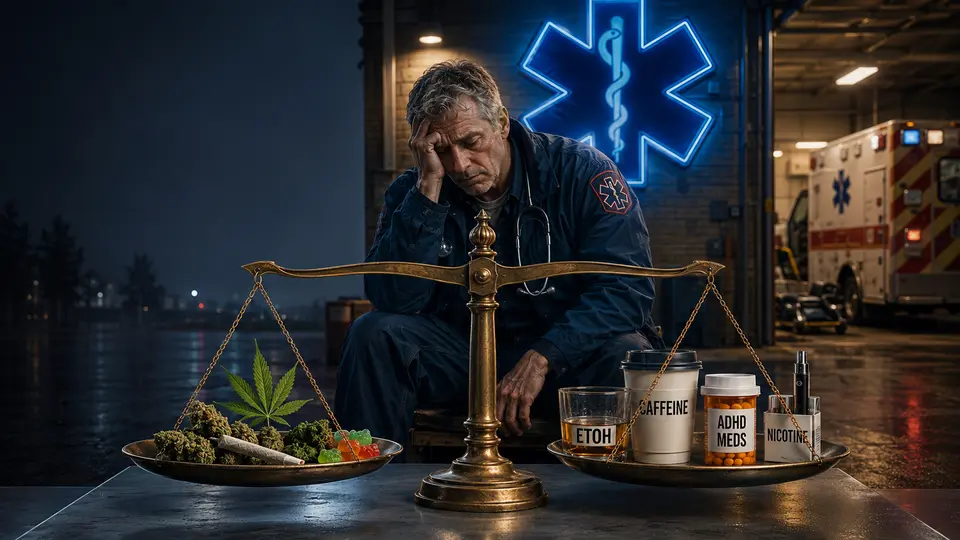
THE POSITION: Cannabis should be legal for adults who choose to use it. EMS providers should nevertheless be held to a clear, substance-neutral standard: fit for duty, free from impairment, and able to safely perform the job.
Prepared for discussion, verification, and good-faith disagreement.
Executive Summary
This paper does not call for a ban on cannabis. It does not equate every cannabis user with an impaired provider. It does not pretend alcohol, prescription medications, nicotine, caffeine, or sleep deprivation are harmless. The argument is narrower—and more practical: legality, prescription status, or personal confidence do not replace a fitness-for-duty assessment in a safety-critical profession.
The current evidence does not establish THC or cannabis as an effective treatment for PTSD. The strongest support remains with structured trauma-focused psychotherapies, with selected medications and targeted treatment for sleep and co-occurring conditions when clinically appropriate. The evidence also supports treating PTSD and substance-use concerns concurrently rather than using cannabis use as a reason to deny trauma care.
Purpose and Scope
The purpose of this paper is to examine a recurring EMS argument: “If you are concerned about THC, why not ban nicotine, caffeine, ADHD medications, SSRIs, alcohol, and everything else that can affect the brain?” That question deserves a serious answer—not a slogan, a culture-war response, or a moral lecture.
This is an evidence-informed discussion, not personal medical advice, legal advice, or an employer policy. The sources are listed so readers can check the claims, inspect the limitations, and disagree with the conclusions where the evidence permits disagreement.
The Core Distinction: Legal Use Is Not the Same as Fitness for Duty
An adult may legally use cannabis and still be unfit to drive an ambulance, administer medications, assess a deteriorating patient, or make high-consequence decisions. The same principle applies to alcohol, sedating medications, severe sleep deprivation, and any other condition that impairs performance.
The correct occupational question is not “Does this person use a substance?” It is “Can this person safely perform the essential functions of the job right now?” NHTSA’s technical report emphasizes that alcohol and marijuana have different pharmacokinetics and that THC concentration does not correlate reliably with impairment.
What the Current Evidence Says About THC and PTSD
1. The evidence does not establish cannabis as a PTSD treatment. The 2023 VA/DoD Clinical Practice Guideline recommends against cannabis and cannabis derivatives for PTSD because of insufficient evidence of efficacy, known adverse effects, and associated risks. The guideline gives stronger support to individual, manualized trauma-focused psychotherapies such as Prolonged Exposure, Cognitive Processing Therapy, and EMDR.
A 2026 scoping review of medicinal cannabis for PTSD likewise concluded that evidence from high-quality randomized controlled trials remains insufficient to support clinical use. More favorable findings often come from observational studies, self-reports, or studies with substantial risk of bias. That does not prove that no individual experiences relief; it means the evidence is not strong enough to call cannabis an established treatment.
2. Subjective relief is real—but it is not the same as recovery. People may report sleeping better, feeling less anxious, or becoming less emotionally overwhelmed after using THC. Those experiences should not be mocked. But symptom quieting can occur without trauma processing, functional improvement, or durable recovery.
3. Cannabis use should not block effective trauma treatment. Research examining trauma-focused treatment among people with PTSD and cannabis use found meaningful improvement across treatment conditions and supports reducing barriers to evidence-based care. The practical implication is not “use cannabis as treatment.” It is “treat the PTSD and address the substance use at the same time.”
4. Early research is interesting, but interesting is not established. A 2024 experimental study found that carefully controlled doses of THC affected fear-extinction and memory-related brain activity in a small PTSD sample. That finding may justify more research. It does not justify assuming that recreational, variable-potency, or unsupervised THC use treats PTSD. A laboratory finding is not a field protocol.
The Half-Life Rebuttal: What Is True and What Is Not
One common response is: “Alcohol has a longer half-life and can still impair someone after they feel sober. THC has a shorter half-life, so it does not do that.” This contains one valid concern and one misleading conclusion.
Alcohol and THC have different pharmacokinetics. THC is highly fat-soluble, and its metabolites may remain detectable for days or weeks, especially in frequent users. A positive test does not prove current impairment—but that is precisely why a THC test cannot be treated as a simple impairment meter.
Acute impairment is also variable. Inhaled cannabis impairment is generally greatest early and declines over several hours. Edibles have delayed onset, variable absorption, and potentially longer effects. Depending on dose, route, and task complexity, research and public-health guidance describe impairment windows ranging from several hours to substantially longer after high oral doses.
Half-life is not the same thing as duration of impairment. Duration of impairment is not the same thing as detectability.
The honest conclusion is not “THC always impairs you the next day.” The honest conclusion is that THC impairment is dose-dependent, product-dependent, person-dependent, and difficult to measure objectively. That uncertainty demands a safety margin—not bravado.
Why the “Ban Nicotine, Caffeine, and SSRIs Too” Argument Misses the Point
This is a fair challenge if the proposed standard is moral purity. It is not a fair challenge if the standard is performance and patient safety.
Nicotine is addictive and harmful; caffeine can worsen anxiety and sleep; prescribed ADHD medication may improve attention when properly monitored; and SSRIs are not intoxicants. None should be waved away, but neither should they be treated as automatically equivalent to THC. The relevant questions are dose, timing, medical supervision, side effects, interactions, and actual job performance.
The fair standard is not “ban everything.” It is “apply the same safety expectation to everything that can impair performance.” A prescribed medication may be entirely compatible with duty—or may require temporary restriction during initiation, dose changes, or adverse effects. The clinical and occupational facts matter more than the label on the bottle.
The Newly Traumatized and the Long-Term Coper
A newly traumatized provider may be searching for immediate relief. After a catastrophic call, sleep disruption, intrusive memories, irritability, hypervigilance, and emotional overload can make any quiet feel like a lifeline. That provider deserves compassion, assessment, and prompt access to competent care—not public humiliation.
The long-term EMS veteran often sees another part of the story. We have watched coping strategies become routines, routines become dependencies, and unresolved trauma collect interest. We know that alcohol, overtime, anger, isolation, food, sex, pills, weed, and constant distraction can all keep a person functional long after they stopped being well.
The newly traumatized person is asking, “What gets me through tonight?” The old hand is asking, “What will this cost you six months from now?” Both questions matter.
Longer-Term Alternatives That Have Better Support
The strongest evidence is not for a magic substance. It is for structured treatment that addresses the trauma, the sleep, the substance use, the relationships, and the occupational environment.
- Trauma-focused psychotherapy: Cognitive Processing Therapy, Prolonged Exposure, EMDR, and related structured approaches are the best-supported primary treatments in the VA/DoD guideline.
- Medication when appropriate: sertraline, paroxetine, fluoxetine, or venlafaxine may be considered when trauma-focused therapy is unavailable, not preferred, or insufficient.
- Sleep treatment: persistent insomnia deserves separate assessment; Cognitive Behavioral Therapy for Insomnia is recommended as a first-line approach for PTSD-associated insomnia.
- Concurrent treatment: PTSD and substance-use concerns can and should be addressed together. Substance use should not automatically disqualify someone from trauma-focused care.
- Supportive recovery practices: exercise, regular sleep-wake structure, peer support, family or couples therapy, treatment of chronic pain, and meaningful connection may support recovery even when they are not stand-alone PTSD treatments.
Prazosin illustrates the need for nuance: the 2023 guideline does not support it for global PTSD symptoms but suggests it may be considered for PTSD-associated nightmares through individualized decision-making. Other popular interventions—including ketamine, MDMA-assisted therapy, somatic treatments, and complementary approaches—should not be marketed as settled answers when the evidence remains mixed, insufficient, or under regulatory review.
What a Fair EMS Policy Should Actually Say
A defensible policy should protect patients and providers at the same time. It should not punish a person merely for having PTSD, ADHD, depression, chronic pain, or another medical condition. It should not assume that a positive test proves current impairment. It should not force people to choose between honesty and employment.
It should establish a clear, substance-neutral fitness-for-duty process that considers:
- current impairment, not moral character;
- essential job functions, including driving and clinical decision-making;
- medical supervision and adherence to a legitimate treatment plan;
- recent initiation or dose changes;
- side effects, interactions, and co-use of substances;
- the provider’s ability to recognize limitations and self-remove from duty;
- confidential referral, treatment, return-to-duty, and follow-up pathways.
The Bench Seat Lesson
I am not a THC user. I support legal access for adults who choose to use it. I also believe that EMS providers—like all safety-critical professionals—must be fit for duty, regardless of whether impairment comes from alcohol, THC, a prescription medication, sleep deprivation, untreated PTSD, or something else entirely.
I am not judging the person who grabbed the first thing that made the pain quiet. I am warning them not to mistake quiet for healed.
The grown-up answer is not prohibition. It is accountability without moral panic, compassion without blind endorsement, and one standard for every potentially impairing factor:
Can you safely do the job right now?
If the answer is no, the next step should not be shame. It should be help, honest assessment, and a path back to health—and back to the truck only when the provider is truly ready.
Sources and Receipts
- VA/DoD Clinical Practice Guideline for PTSD and Acute Stress Disorder (2023). psychiatryonline.org
- VA National Center for PTSD, Clinician’s Guide to Medications for PTSD. ptsd.va.gov
- Efficacy, effectiveness and safety of medical cannabis in PTSD: a scoping review (2026), PMID 42210342. pubmed.ncbi.nlm.nih.gov
- VA National Center for PTSD, Cannabis Use and PTSD Among Veterans. ptsd.va.gov
- Cannabis use and trauma-focused treatment for co-occurring PTSD and substance use disorders (2024), PMID 38266511. pubmed.ncbi.nlm.nih.gov
- The impact of substance use on posttraumatic stress disorder symptoms and treatment discontinuation (2023), PMID 38085564. pubmed.ncbi.nlm.nih.gov
- Dose-dependent effect of acute THC on extinction memory recall in PTSD (2024), PMID 39412674. pubmed.ncbi.nlm.nih.gov
- NHTSA, Marijuana-Impaired Driving: A Report to Congress. rosap.ntl.bts.gov
- Clinical chemistry and toxicology review of cannabis pharmacokinetics. pmc.ncbi.nlm.nih.gov
- CDC, Cannabis and Driving. cdc.gov
- UC San Diego TREDS, Cannabis and Driving Pocket Guide. treds.ucsd.edu
- Sydney University review of cannabis impairment duration. sydney.edu.au
- FDA decision and evidence concerns regarding MDMA-assisted therapy for PTSD. reuters.com
This paper summarizes the sources as available in August 2026. It distinguishes established guideline recommendations from emerging, observational, or limited evidence. Readers are encouraged to open the original sources, inspect methods and limitations, and disagree in good faith. This is an evidence-informed discussion, not personal medical advice, legal advice, or an employer policy.