Introduction
Emergency medicine prides itself on evidence-based practice.
Protocols guide airway management, medication administration, cardiac care, and trauma treatment. Clinical decisions are supported by research, guidelines, and carefully studied interventions.
For decades, however, the mental health of the people performing those interventions followed a very different protocol.
It went something like this:
Drink coffee. Make a dark joke. Get back in service.
The assumption was simple: if someone couldn’t handle the emotional weight of the job, they probably shouldn’t be doing it.
Modern research has begun to challenge that assumption.
Studies examining emergency responders consistently show elevated rates of mental-health symptoms among EMS personnel. One meta-analysis estimated that approximately 11% of ambulance personnel meet criteria for post-traumatic stress disorder, with similar prevalence rates for depression and anxiety (Petrie et al., 2021).
Other surveys suggest that as many as 40% of EMS providers report some form of mental-health concern during their careers, including burnout, depression, or post-traumatic stress symptoms (Bentley et al., 2021).
These findings do not suggest that EMS providers are fragile.
They suggest something simpler.
The job exposes people to difficult things.
And those experiences do not simply disappear.
The Shoebox
Among responders, a common way of describing coping with difficult calls is compartmentalization.
A call happens. The provider finishes the job. And the experience gets mentally placed somewhere out of the way.
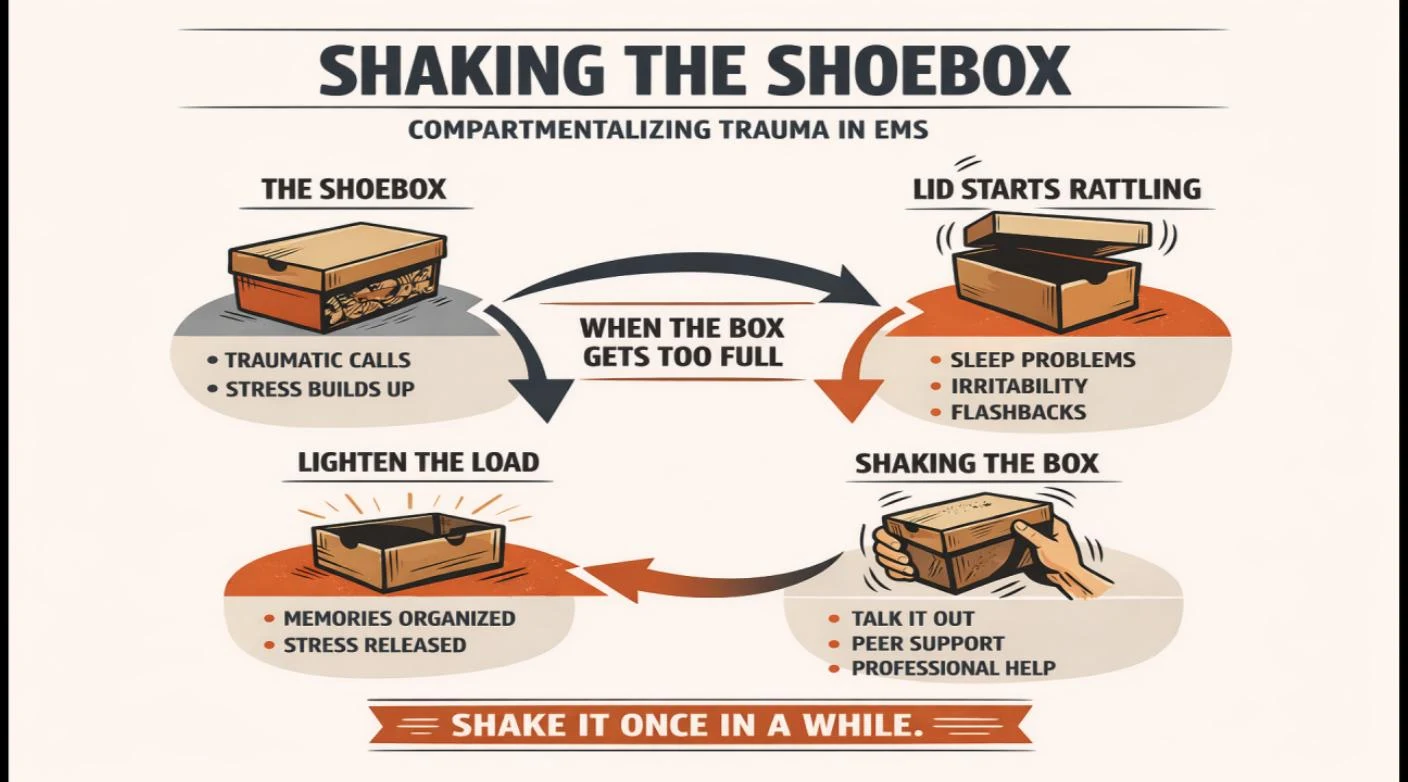
For the purposes of this paper, that mental container is called the shoebox.
Compartmentalization is not inherently unhealthy. In fact, it is often necessary. A paramedic cannot stop mid-resuscitation to process emotional distress. The brain temporarily stores the experience so the provider can continue functioning.
Psychological research recognizes compartmentalization as a common coping strategy in high-stress occupations (Varker et al., 2021).
But the job keeps adding things to the box.
Traumatic injuries. Pediatric deaths. Family members screaming in hallways. Moments that do not appear in textbooks or protocol manuals.
Over time the accumulation can become significant.
Repeated exposure to traumatic incidents, combined with shift work, sleep disruption, and occupational stress, contributes to higher rates of burnout, anxiety, and trauma-related symptoms among first responders (Wild et al., 2020).
In simpler terms:
The shoebox fills up.
When the Box Starts to Rattle
Eventually the accumulation shows up somewhere.
Sleep gets disrupted. Irritability increases. Old calls suddenly appear in quiet moments.
These reactions are not unusual.
Research consistently demonstrates that first responders experience higher rates of trauma-related stress compared with the general population (Petrie et al., 2021).
More concerning is the relationship between occupational stress and suicide risk. Studies examining mortality among emergency responders have found elevated suicide rates compared with non-EMS populations (Stanley et al., 2020).
The National Institute for Occupational Safety and Health has identified occupational stress, trauma exposure, and sleep disruption as key contributors to suicide risk among first responders (CDC, 2021).
Shaking the Shoebox
The solution is not pretending the box does not exist.
And the solution is not dumping the entire contents onto the station floor.
The solution is learning to shake the shoebox once in a while.
“Shaking the shoebox” refers to the intentional processing of difficult experiences through conversation, peer support, and—when necessary—professional mental-health care.
Narrative processing—the act of telling the story—helps organize traumatic memories and reduce emotional distress (Halpern et al., 2020).
Social support is one of the strongest protective factors against occupational stress among first responders (Stanley et al., 2020).
In academic language, these interventions allow the brain to contextualize traumatic experiences.
In the language of the street:
Talking about the call keeps it from living rent-free in your head.
The Evidence Finally Catches Up
One of the quiet ironies of EMS is that the profession prides itself on scientific evidence.
Yet the mental-health lessons that research is confirming today have long been understood informally by experienced responders.
Veteran providers have always known several things: the job exposes people to trauma; compartmentalization helps providers function in the moment; unprocessed stress accumulates; and social support helps lighten the load.
Science is now catching up to what the street figured out years ago.
What EMS Leaders Can Do Tomorrow Morning
Recognizing the problem is only the first step.
Evidence from occupational health research suggests several practical interventions that EMS agencies can implement to support provider wellness.
1. Establish external mental-health partnerships. Confidentiality concerns remain one of the biggest barriers to mental-health care in EMS. Providers often hesitate to discuss personal struggles within their own organizations because they worry about potential career consequences. External mental-health providers reduce this barrier: independent clinicians experienced in first-responder trauma offer true confidentiality, specialized trauma-informed care, and independence from departmental oversight. Research shows that responders are significantly more likely to seek help when services are provided outside the chain of command (SAMHSA, 2022). Peer-support programs should serve as the bridge that connects providers to professional care when needed.
2. Strengthen peer-support programs. Peer support works because EMS culture values shared experience. A responder who has run the same calls understands the realities of the job in ways that outsiders may not. Peer-support programs reduce stigma, normalize reactions to difficult calls, and increase the likelihood that providers will seek help when needed (EMS.gov, 2021). Effective programs include trained peer supporters, confidential communication channels, access to professional referral resources, and visible leadership support. Peer support is not therapy. But it often opens the door to it.
3. Expand mental-health education in EMS training. Historically, EMS education focused almost exclusively on clinical skills. Students learned airway management, pharmacology, trauma assessment, and patient documentation. What they rarely learned was how to manage the psychological weight of the job. Recent updates to EMS educational materials are beginning to address this gap. Current EMT textbooks and national standards include expanded sections on provider wellness, burnout recognition, and resilience strategies (NHTSA, 2023). This shift reflects growing recognition that sustaining EMS careers requires both clinical competence and psychological resilience.
4. Normalize conversations about difficult calls. Sometimes the most effective intervention is also the simplest. Let people talk. Research shows that discussing traumatic experiences with trusted peers helps reduce long-term psychological distress (Halpern et al., 2020). Departments that normalize these conversations create cultures where seeking help is viewed as strength rather than weakness. When people talk, the shoebox gets lighter.
5. Protect the support systems outside the job. One of the strongest protective factors against occupational stress is something EMS agencies often overlook. Life outside the job. Family members, friends, and relationships outside emergency services provide critical emotional balance for responders. Strong social support networks are associated with reduced risk of depression, PTSD symptoms, and suicide among first responders (Stanley et al., 2020). EMS may be a calling. But it should never be someone’s entire identity.
Conclusion
Emergency Medical Services has always relied on scientific evidence to improve patient care.
Today the evidence is finally catching up to what experienced providers have known for years.
The job is demanding.
The emotional impact is real.
But with strong peer networks, accessible mental-health support, and honest conversations about the realities of the profession, EMS providers can build long and meaningful careers.
References
- Bentley, M. A., Crawford, J. M., Wilkins, J. R., Fernandez, A. R., & Studnek, J. R. (2021). Depression, anxiety, and stress among nationally certified EMS professionals. Prehospital Emergency Care, 25(2), 184–191.
- CDC. (2021). Suicide among first responders. National Institute for Occupational Safety and Health.
- EMS.gov. (2021). First responder mental health and suicide: An evidence-based approach.
- Halpern, J., Maunder, R., Schwartz, B., & Gurevich, M. (2020). Emotional sequelae after critical incidents in emergency responders. Journal of Occupational Health Psychology, 25(4), 291–302.
- NHTSA. (2023). National EMS education standards.
- Petrie, K., Milligan-Saville, J., Gayed, A., et al. (2021). Prevalence of PTSD among emergency service workers. Occupational Medicine.
- SAMHSA. (2022). First responder behavioral health resources.
- Stanley, I. H., Hom, M. A., & Joiner, T. E. (2020). Suicide among first responders. Clinical Psychology Review.
- Varker, T. et al. (2021). Coping strategies in high-stress occupations. Psychological research review.
- Wild, J., Smith, K., Thompson, E., Béar, F., Lommen, M., & Ehlers, A. (2020). Resilience in emergency responders. European Journal of Psychotraumatology.
If you’re a provider struggling with the weight of this job, please reach out—to a peer support team, your EAP, a counselor who understands first responder culture, or the 988 Suicide & Crisis Lifeline (call or text 988). You don’t have to wait until the box is rattling.