Teaching Pre-Attentive Perceptual Processing as a Core Competency in Prehospital Clinical Reasoning — Before You Ask the First Question.
This framework did not originate in an academic literature review or a curriculum committee meeting. It began with an old grumpy paramedic instructor browsing the internet after one too many CQIs kept revealing the same errors over and over.
Abstract
Emergency Medical Services education has long taught providers to collect clinical data sequentially and apply algorithmic decision-making frameworks. This approach produces providers who are technically competent but perceptually undertrained — capable of executing a protocol but not yet capable of recognizing, before the first question is asked, that a patient is critically ill.
Nobody handed me this framework in a classroom. I was sitting at my desk one night, cross-eyed from one too many CQI reviews, staring at documentation that told me everything about what the provider charted and nothing about whether they actually knew what was wrong with the patient — when I stumbled across a man named Daniel Tammet. He’s a British savant who experiences numbers as shapes and colors and textures — he doesn’t calculate pi, he walks through it like a landscape. And I sat there thinking: that’s it. That’s exactly what happens in the first fifteen seconds of a bad call. Not the algorithm. Not the checklist. Something older than both of those. The body in that room is already broadcasting, and if you’ve been doing this long enough, you receive it before you know you’re receiving it. Tammet just gave me the language to say so out loud.
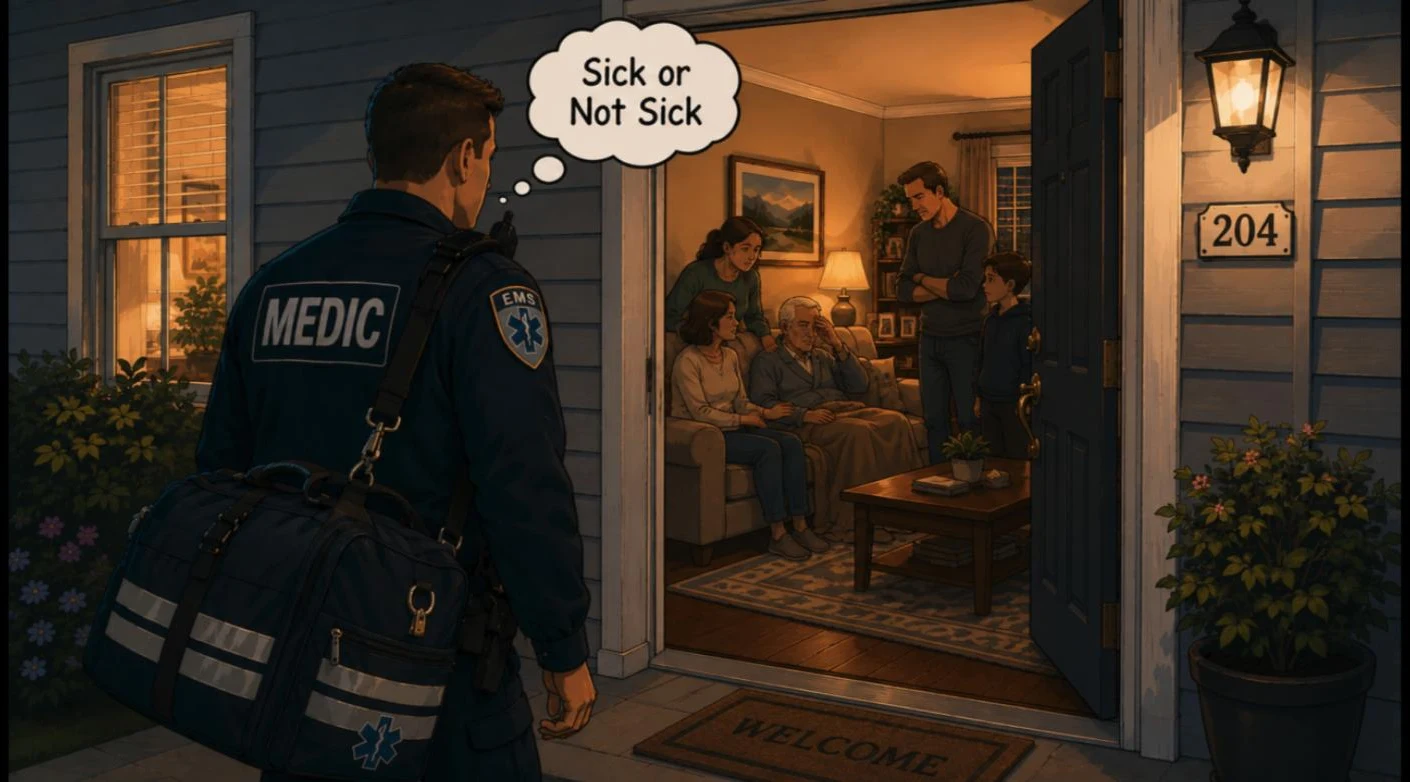
Thirty-two years on the box will teach you things no curriculum has the nerve to print. The monitor will lie to you. The patient will lie to you. The family will look you dead in the eye and tell you he only had two beers. None of those matters — if you know how to read the room. The provider who can answer Sick or Not Sick with one foot still in the doorway isn’t guessing. They’re not running on instinct. They’re running on something we’ve never bothered to teach deliberately — and that stops here.
Sick or Not Sick is the right question. It has always been the right question. What this paper proposes is something the academics will find uncomfortable and the street medics will recognize immediately: you can know the answer before you walk through the door. Not as a guess. Not as a hunch. As a trained, deliberate, repeatable clinical skill — built the same way every other skill gets built. On purpose. Under supervision. With feedback. We teach you to read the patient. Not the monitor. And to keep reading.
I. The Gap Between What We Teach and What Experienced Providers Actually Do
There is a persistent and largely unacknowledged gap in EMS education between the cognitive processes we teach and the cognitive processes that experienced providers develop over time. Nobody talks about it at conferences. It doesn’t show up in accreditation standards. But every seasoned provider in every room knows exactly what it is.
What we teach is sequential and algorithmic: Scene safety. BSI. General impression. Chief complaint. SAMPLE. OPQRST. Vital signs. Physical assessment. Treatment. Transport decision. The architecture is logical, reproducible, and defensible. It is also, in the hands of an expert clinician, almost entirely retrospective — a documentation framework that captures decisions the experienced provider had already made within seconds of entering the room. The checklist didn’t drive the call. It rode along and took notes.
What experts actually do is different. They walk in. Something registers. They move differently — faster, or more carefully, or with a particular quality of attention — before a single finding is named. The algorithm, when they run it, confirms what the gestalt already told them.
This is not mysticism. It is expertise. And unlike mysticism, it is teachable. But only if we are willing to acknowledge it, name it, and build curriculum around it deliberately — instead of just hoping providers pick it up somewhere between their third year and their tenth.
The teaching framework described in this paper is built on a single foundational claim: the sensation that experienced providers call “reading the room” is a legitimate clinical skill, grounded in pre-attentive perceptual processing, that can be taught systematically to novice providers using structured scenario-based methodology and metacognitive verbalization techniques.
II. The Tammet Connection: An Unlikely Conceptual Bridge
Daniel Tammet is a British writer, linguist, and savant with high-functioning autism and synesthesia. He is best known for reciting pi to 22,514 decimal places from memory, and for learning conversational Icelandic in one week for a televised demonstration. His accounts of his own cognition, particularly in his memoirs Born on a Blue Day (2006) and Thinking in Numbers (2012), provide a detailed first-person description of cross-modal perceptual processing: the experience of perceiving abstract information — numbers, language, concepts — as textures, colors, spatial landscapes, and emotional registers simultaneously.
Tammet did not set out to build a teaching methodology. He was describing his own perceptual reality. But his descriptions illuminate something that cognitive scientists have documented in expert practitioners across multiple high-stakes fields: the capacity to receive complex, multi-channel perceptual information as an integrated whole — a gestalt — before sequential analytical processing engages.
Tammet does not teach facts. He teaches phenomenology. The pedagogy is not ‘here is the information’ — it is ‘here is what it feels like to be inside the information.’ That distinction is the entire argument of this paper.
Applied to EMS education, the Tammet model suggests that what we call clinical intuition is not vague feeling but highly integrated perceptual processing — and that the goal of training is not to suppress this processing in favor of algorithmic checklists, but to cultivate it deliberately while giving providers the language to name and trust what they perceive.
The connection was not made in a literature review. It was made by a paramedic instructor, thirty-two years in the field, cross-eyed over CQI reports at ten o’clock at night — who encountered Tammet’s work while browsing the internet and recognized — immediately, pre-analytically, in the way this paper is arguing we should teach — that Tammet was describing what happens in the first fifteen seconds of a critical call. Sometimes the curriculum committee doesn’t find the idea. The idea finds the right old grumpy paramedic.
III. The Clinical Foundation: Impending Doom as a Teaching Anchor
Medical and EMS curricula already teach “feeling of impending doom” as a legitimate clinical finding. It appears in the differential diagnosis of anaphylaxis, acute myocardial infarction, massive pulmonary embolism, and aortic dissection. Students are taught to ask about it. Providers are taught to document it. It is, in standard curriculum, a patient-reported symptom collected in the subjective portion of the assessment.
The argument of this paper begins with a simple observation: the medical and EMS communities have already conceded the validity of the phenomenon. The teaching has simply stopped short of its logical extension. They put it in the textbook and then apparently forgot to teach the next sentence.
If a patient can feel impending doom, it is because their body is already broadcasting it — through autonomic discharge, perfusion changes, altered mental status, postural shifts, vocal register changes, skin color and texture, respiratory pattern reorganization. These signals exist before the patient has language for what they are experiencing. They exist, therefore, before the patient can report them.
A trained provider walking into that room is receiving that broadcast. The question is not whether the signals are present. The question is whether the provider has been trained to receive them — or whether we handed them a checklist and told them to get started.
The Three-Tier Model of Clinical Doom Perception
The following model organizes the progression from standard teaching to expert-level perceptual processing:
Tier One — Patient-Reported Doom. Detecting source: patient verbalization. Teaching method: standard curriculum — ask and document.
Tier Two — Provider-Perceived Doom. Detecting source: trained perceptual reading of broadcast signals. Teaching method: structured observation, metacognitive verbalization.
Tier Three — Pre-Verbal Clinical Synthesis. Detecting source: integrated gestalt — sub-threshold signal aggregation. Teaching method: staged scenarios, debrief, deliberate practice.
Tier One is what every EMT and paramedic program teaches. Tier Two is what experienced providers develop over years of field exposure — and what this curriculum proposes to teach explicitly, rather than leaving it to chance and accumulated scar tissue. Tier Three is the target state: the integrated perceptual synthesis that allows a provider to move faster, think more clearly, and act earlier under conditions of time pressure and diagnostic uncertainty.
IV. The Academic Framework: Evidence-Based Foundations
The teaching methodology described in this paper is not a departure from evidence-based educational practice. It is an application of well-established cognitive science and educational theory to a domain — prehospital emergency medicine — where these frameworks have been underutilized. For the skeptics in the room: the citations are real, the research is solid, and none of it requires you to burn your protocols.
Naturalistic Decision Making and Recognition-Primed Decision Model. Gary Klein’s Recognition-Primed Decision (RPD) model, developed through research with firefighters, military commanders, and emergency physicians, establishes that expert decision-making under time pressure is not analytical. Experts do not generate options and evaluate them. They recognize a situation as belonging to a known pattern and act on the first option that fits. The quality of expert decision-making is therefore a direct function of the richness of their pattern library — and the speed and accuracy with which they can match an incoming situation to a pattern. In other words: Klein spent years studying people who do exactly what good paramedics do and wrote a book about it.
The opening exercise described in Section V is designed to begin building that pattern library from the first scenario, rather than waiting for field experience to build it over years. It is, in Klein’s terms, accelerated naturalistic decision-making training.
Dual Process Theory. Kahneman’s System 1 / System 2 framework distinguishes between fast, automatic, pattern-based cognition (System 1) and slow, deliberate, analytical cognition (System 2). EMS protocol structures are System 2 tools applied to System 1 environments. Under time pressure and cognitive load, System 2 processing degrades. System 1, if well-calibrated, does not.
Standard EMS education trains System 2 while implicitly relying on field exposure to calibrate System 1. This curriculum proposes to train both, beginning with System 1 calibration as a foundational competency. Because waiting for the field to do it is how we get providers who are five years in and still waiting for permission to trust what they already know.
Pre-Attentive Processing. Treisman and Gelade’s Feature Integration Theory established that the visual system — and by extension, multi-sensory perceptual systems — process certain categories of information pre-attentively: automatically, in parallel, prior to conscious attention being directed to specific features. Color, motion, spatial orientation, and certain auditory and olfactory features are processed pre-attentively.
In clinical terms, this means that a provider walking into a scene is already processing skin color, postural information, respiratory pattern, ambient sound, and olfactory data before any deliberate assessment begins. The exercise in Section V creates a structured opportunity to surface and examine this processing.
Metacognitive Verbalization. Ericsson and Simon’s work on protocol analysis and deliberate practice establishes that verbalizing implicit reasoning — converting pre-conscious perceptual impressions into explicit language — accelerates expertise development by making tacit knowledge available for examination, feedback, and refinement. The requirement to write one sentence following the opening observation exercise is not a documentation exercise. It is a metacognitive intervention. One sentence. Fifteen seconds. That’s the whole ask — and it’s harder than it sounds for providers who have been trained to skip straight to the number.
Clinical Intuition Research. Croskerry’s work on cognitive error in emergency medicine diagnosis provides the complementary framework: intuitive processes produce rapid, accurate pattern-matching in experienced providers but are also subject to systematic biases that deliberate practice can identify and correct. The debrief component of the exercise described in Section V serves this function — not to override intuitive processing, but to calibrate it.
V. The Teaching Exercise: First Impression Clinical Reasoning
The following exercise operationalizes the framework described above into a repeatable, scenario-agnostic training structure applicable at any level of provider education. It costs nothing, requires no equipment, and takes fifteen seconds. There is no excuse for not doing it.
Formal title: First Impression Clinical Reasoning: A Pre-Attentive Perceptual Processing Exercise.
Instructional objective: Upon completion of repeated iterations of this exercise, the provider will demonstrate the ability to identify and articulate integrated pre-attentive perceptual signals at initial scene contact, and will demonstrate improved correlation between initial perceptual impression and subsequent clinical findings.
Setup. Prior to any scenario — before the manikin, before the dispatch note, before the vital signs card — the instructor stages the environment with deliberate perceptual texture: patient positioning that carries clinical meaning (tripod position, supine with head turned, seated and leaning forward); family or bystander positioning and behavior (standing versus seated, clustered versus dispersed, making eye contact with the provider or avoiding it); ambient sensory cues appropriate to the scenario (odor, lighting level, sound, temperature). Nothing labeled. Nothing explained. No chief complaint announced.
The instruction: “You are going to walk into this room. You have fifteen seconds. You will not touch the patient. You will not ask a question. At the end of fifteen seconds, you will write one sentence about what you feel.”
The instruction is deliberate in its simplicity and its ambiguity. “What you feel” is not an invitation to clinical assessment. It is an invitation to pre-attentive perceptual report. The ambiguity is intentional: providers who default to clinical language (“the patient appears diaphoretic”) are approaching the exercise analytically. Providers who report perceptual impressions (“something in here is working too hard”) are operating in the register the exercise is designed to train. Watch which category your students fall into. It will tell you everything about where they are in their development.
The debrief. After the scenario is completed in full — assessment, treatment, transport decision — the instructor returns to the written sentence. The debrief proceeds in three movements: What did you write? What did the patient turn out to be? Where did your sentence land?
The instructor’s role in the debrief is not to validate or correct the sentence. It is to trace the line between the pre-attentive impression and the clinical finding — to demonstrate, repeatedly and with accumulating evidence, that the signals were present and the impression was accurate before a single question was asked.
VI. The Vocabulary of Doom: Teaching Sensory Language
One of the underrecognized barriers to teaching pre-attentive processing is the absence of a clinical vocabulary for it. Providers are trained in the language of objective findings. They are not trained in the language of perceptual impressions — and without language, the impressions remain inaccessible to examination, feedback, and refinement. So they file it under “gut feeling” and apologize for it. We are done accepting that apology.
Part of the instructor’s role in this framework is to model and reinforce a clinical vocabulary for pre-attentive perception. The following examples illustrate what this language sounds like in practice.
The patient who is about to be very sick has a particular quality of stillness. Not the stillness of rest — the stillness of conservation. The body has redirected its resources. The stillness is load-bearing. It has weight. A provider trained to recognize this shape will feel it before a blood pressure is obtained.
The room that says go now has a frequency. The family is standing instead of sitting. The patient tracks the provider with their eyes but does not turn their head. There is a smell that does not belong to the furniture. The breathing, heard from the doorway, has a quality of effort. None of these findings are on a checklist. All of them are clinical data.
The patient who is not sick is managing the interaction. They are annoyed at the interruption. Their color is argument, not compensation. They use complete sentences with subordinate clauses. Their hands are expressive. This is also data — and recognizing it allows the provider to calibrate accordingly.
The instructor’s task is to make this language normal — to establish, through modeling and repetition, that describing what a room “feels like” is not vague or unscientific. It is the most precise possible description of pre-attentive perceptual data, and it is what experienced clinicians have always done, whether or not they had a framework for naming it.
VII. The Cognitive Sequence: From Sensation to Decision
Standard EMS education produces the following cognitive sequence: Algorithm → Data Collection → Pattern Recognition → Decision.
The framework proposed in this paper produces the following sequence: Sensation → Language → Pattern Recognition → Algorithm → Decision.
The difference is not merely academic. In the standard sequence, the algorithm structures perception — providers look for what the algorithm tells them to look for. In the proposed sequence, perception structures the algorithm — providers arrive at the algorithm already knowing what they are looking for and use it to confirm and systematize what they have already perceived.
Under conditions of time pressure, this distinction is clinically significant. The provider who is running an algorithm is dependent on the algorithm’s completion. The provider who arrived at a gestalt impression in the first fifteen seconds is acting on that impression from the moment of scene contact — and is using the algorithm to document the decision they have already made.
This is not a critique of algorithmic training. Algorithms are essential. They are the System 2 scaffold that catches what System 1 misses, provides the documentation that protects the patient and the provider, and ensures that the novice provider who has not yet built a pattern library has a structure to follow. The argument of this paper is not to replace the algorithm. It is to build what the algorithm runs on — because right now we are handing people a race car and never teaching them to drive.
VIII. Implementation Guidance
The following guidance is offered for instructors and program directors considering integration of this framework into existing curricula.
Entry points. EMT and AEMT programs: introduce as a framing exercise at the beginning of scenario-based training, before the first full patient assessment scenario. Paramedic programs: introduce during the critical care and medical emergency modules, where pattern recognition most directly affects outcome. Continuing education and recertification: use as an opening exercise in scenario-based refresher training, particularly for providers returning from extended leave or transitioning between practice settings. FTO programs: incorporate into preceptor debriefs as a structured reflection tool — “what did you feel when you walked in, and what did it turn out to be?”
Frequency and repetition. The exercise derives its value from repetition and accumulation. A single iteration produces a novel experience. Ten iterations begin to build a pattern library. The goal is not the exercise itself but the progressive calibration of pre-attentive processing through repeated exposure, verbalization, and debrief. Do it every time. Every scenario. Every class. It takes fifteen seconds and it builds the thing that thirty years used to build by accident.
Instructor posture. The instructor’s most important role in this framework is not evaluation but validation. The default instinct of providers — particularly early in training — is to distrust pre-attentive impressions in favor of objective data. The instructor’s job is to demonstrate, through the debrief, that the impression was data. Correction comes later, and only when the impression was demonstrably miscalibrated and the miscalibration is traceable to a specific perceptual error. Not every sentence will land perfectly. That’s not failure — that’s calibration in progress. The student who writes a wrong sentence and understands why it was wrong is already ahead of the student who never wrote one at all.
IX. Conclusion
The feeling of impending doom is already in the textbook. The medical and EMS communities have already acknowledged that a patient can feel, before they can name, that something is terribly wrong. What this paper proposes is the logical extension of that acknowledgment: that a trained provider can feel it too, and feel it earlier — before the patient has found the words, before the algorithm has been run, before the numbers have confirmed what the room was already saying.
This is not a new idea dressed in new language. It is an old reality, practiced by experienced providers for as long as there have been experienced providers, finally given a framework, a vocabulary, and a teaching methodology grounded in established cognitive science. We just never bothered to write it down. Until now.
The integration of multi-channel perceptual data into a pre-verbal gestalt arrives faster than analysis, more completely than any single data point, and — when properly trained and calibrated — with a reliability that experience has always known and education has been slow to teach.
The patient knew before they told you. You can know before they tell you. That’s not instinct. That’s training.
References
- Klein, G. (1998). Sources of Power: How People Make Decisions. MIT Press.
- Kahneman, D. (2011). Thinking, Fast and Slow. Farrar, Straus and Giroux.
- Treisman, A. & Gelade, G. (1980). A feature-integration theory of attention. Cognitive Psychology, 12(1), 97–136.
- Ericsson, K.A. & Simon, H.A. (1993). Protocol Analysis: Verbal Reports as Data (Revised ed.). MIT Press.
- Croskerry, P. (2003). The importance of cognitive errors in diagnosis and strategies to minimize them. Academic Emergency Medicine, 10(11), 1130–1136.
- Tammet, D. (2006). Born on a Blue Day: Inside the Extraordinary Mind of an Autistic Savant. Free Press.
- Tammet, D. (2012). Thinking in Numbers: On Life, Love, Meaning, and Math. Little, Brown and Company.
Michael Doss is Training & Education Coordinator for Ambulnz by DocGo, Tennessee Market, and an adjunct EMT instructor. He retired from the Nashville Fire Department after 32 years of credited service in the EMS division. He holds multiple instructor credentials through NAEMT and the American Heart Association. He is the author of Lessons From The Bench Seat: What They Don’t Teach You in EMT School. The connection between Daniel Tammet’s perceptual experience and prehospital clinical reasoning came to him while browsing the internet for ways to help new providers be better clinicians and not just box checkers.