Let me tell you something about copy and paste documentation.
Actually—let me back up. Let me ask you something first.
When was the last time you wrote a narrative? Not pulled one. Not cleared the old one and dropped your name in. Wrote one. From scratch. From memory. From what you actually saw and heard and assessed on that call.
Go ahead and think about it. I’ll wait.
...
Yeah. That’s what I thought.
Here’s the thing nobody wants to say out loud in a CQI meeting: copy and paste doesn’t just make your documentation lazy. It makes you lazy. And not lazy like “forgot to make coffee” lazy. Lazy like “missed a clinical detail that mattered” lazy. The dangerous kind. The kind that follows you into a deposition conference room on a Tuesday afternoon about a call you barely remember.
But we’ll get there.
Meet Skippy
Now let me introduce you to somebody.
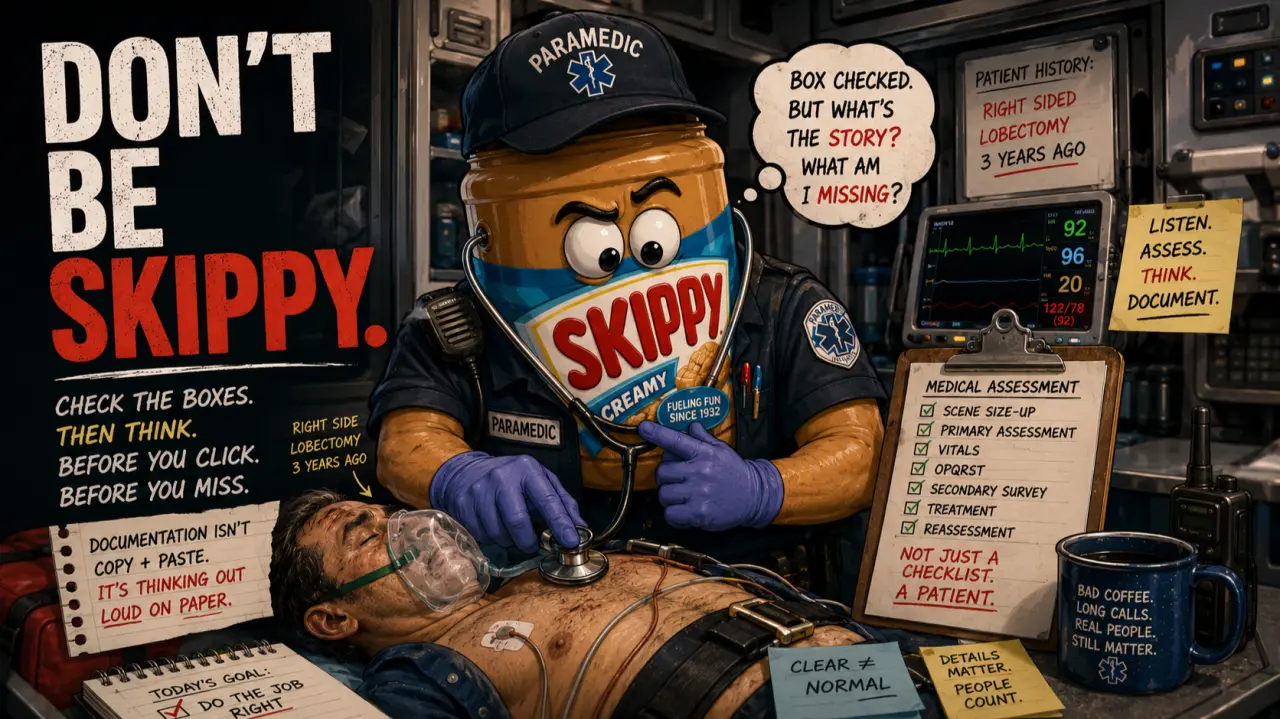
I’m gonna call him Skippy.
Skippy is not a bad person. Skippy passed his NREMT. Skippy shows up on time, mostly. Skippy genuinely wants to help people—or at least he did when he started. Somewhere around month four, Skippy discovered the copy and paste function in the ePCR, and something in his brain just... relaxed.
Permanently.
Skippy has a narrative. It’s a good narrative, actually. Solid structure. Covers the basics. He wrote it one time—one good time—about eighteen months ago on a chest pain call that went well. Patient did fine. Skippy felt great about the documentation. Saved it.
And then he just... kept using it.
Every chest pain since then? That narrative. Modified slightly. Name swapped. Age adjusted. Copy. Paste. Clear. Sign. On to the next one.
But here’s where I need you to understand something important. Because it’s not just the narrative section.
Oh no.
Skippy is an equal opportunity corner-cutter. Skippy has discovered that the dropdowns and checkboxes are just as copy-pasteable as the free text, and he has applied that same magnificent lack of engagement across the entire PCR like he’s speed-running a video game nobody told him was real.
Breath sounds field: Equal. Bilateral. Clear.
Click. Done. Next field.
Patient history section, right underneath it, filled out from the intake information the nurse handed him at the door:
Right sided lobectomy. Three years ago.
...
Now.
I want you to sit with that for a second.
I want you to actually let that land.
This patient—this specific patient, on this specific call—is walking around this earth with one lobe fewer than God originally issued. The right side of their chest has been surgically rearranged. There are anatomical realities happening in that thorax that did not exist before somebody in a surgical suite made some permanent decisions.
And Skippy’s assessment says: equal bilateral.
Equal.
Bilateral.
Son.
How It Sounds From the Other Chair
Now think about what that tells me as a reviewer. Think about what that tells a physician reading the handoff. Think about what that tells a plaintiff’s attorney—and I want you to really sit in that chair for a moment—a plaintiff’s attorney who is sharp and well-prepared and reading your PCR out loud to twelve people in a jury box who have never been inside an ambulance in their lives.
“Ladies and gentlemen, the paramedic documented clear and equal breath sounds bilaterally. The patient’s own medical history, documented four fields above that on the same form, notes a right-sided lobectomy performed three years prior. The paramedic, apparently, did not notice the conflict. Or perhaps... did not listen at all.”
Whew.
You want to know what that sounds like from the witness stand?
Neither do I. And I have been close enough to that experience to know I never want to be closer.
But here is what really gets me. Here’s what keeps this from being just a liability conversation and makes it a clinical conversation.
If you actually listened—if you put that stethoscope on that chest with intention instead of obligation—you would hear something. You would have to hear something different on that right side. Maybe diminished. Maybe absent in one field. Maybe adventitious sounds that only make sense once you understand what you’re working with anatomically. Maybe nothing alarming at all—but different. And different means something. Different means you’re paying attention. Different means you understood that this patient’s baseline is not the same as the last patient’s baseline and you had the professional presence of mind to note it.
That’s assessment.
That’s documentation.
That’s the job.
But Skippy didn’t listen. Or Skippy listened and didn’t process it. Or Skippy processed it and didn’t document it because the dropdown was already sitting there on equal bilateral from the last call and his thumb just...
clicked.
One thumb. One click. One dropdown choice that directly contradicts the patient’s own surgical history sitting four fields north of it on the same screen.
And here’s what that tells me—and I don’t mean this as a legal observation, I mean this as a clinical one:
Skippy’s lung sounds are always clear and equal bilaterally because Skippy stopped listening somewhere along the way. The checkbox didn’t make him lazy. The checkbox revealed it. The ePCR just gave him a faster way to document the assessment he wasn’t doing.
Documentation Is Thinking Out Loud
That’s the part that keeps me up at night a lot more than any deposition.
Because documentation is not filing. Documentation is not a box you check so the billing department stops emailing you. Documentation is thinking out loud on paper. It is the written record of your clinical brain doing its job in real time—and when you automate that process, when you reduce it to clicks and pastes and saved templates, you are not saving time.
You are practicing not thinking.
And that is a skill you will absolutely perfect if you work at it long enough.
When you write a narrative from scratch—when you actually engage with the blank field instead of filling it from a saved file—you relive the call. You go back to that living room. You see the patient. You remember what they said and what they didn’t say. You feel the assessment in your hands again. You reconstruct the picture—and sometimes, right there in the middle of typing, you catch something you underweighted on scene. Something subtle. Something that deserves a note. Something that might matter at 0200 when the ER calls you back.
Copy and paste skips all of that.
You’re not reflecting. You’re replicating. And there is a massive difference between those two words.
Skippy is not learning anything. Call after call, shift after shift, Skippy is getting less sharp. Not because he’s dumb. Not because he doesn’t care. But because he opted out of the mental exercise without realizing it. Found a shortcut and dressed it up as efficiency and didn’t look too hard at what was underneath.
The streets are keeping score though.
They always are.
And one of these days—and I have watched this happen more than once, which is exactly why I sound like this—Skippy is going to have a call that doesn’t fit the template. A presentation that’s quiet and subtle and doesn’t announce itself. A patient who is compensating hard and holding it together and not showing the textbook signs because the human body did not read the same textbook Skippy did.
And Skippy is going to document what he always documents. Because that is the groove his brain lives in now. And he is going to miss something that mattered.
Not because he’s malicious.
Because he stopped practicing, and the streets don’t grade on effort.
FTOs: This Part Is Yours
But here’s where I pump the brakes for just a second.
Because Skippy didn’t always create himself.
Sometimes Skippy had a little help getting there.
Let’s talk about Field Training Officers.
Some of you—and I want to be precise here because I mean this with everything I’ve got—some of you are doing genuinely good work out in that passenger seat. You are the ones who hand a new hire a blank narrative field on day one and say go ahead, write it, tell me what you saw. You make them reconstruct the call from memory. You sit with them while they fumble through it. You ask why they documented what they documented—not to embarrass them, but because the question itself is the lesson. You treat the narrative and the assessment fields like the clinical exercise they actually are instead of a formality standing between you and quarters.
You know who you are.
And I want you to hear this clearly: somebody notices. Maybe not your supervisor. Maybe not at the quarterly meeting over bad catering and lukewarm coffee. But the medics those new hires become—sharp, thinking, writing-from-memory providers who still give a damn three years in—that is your work. Your fingerprints on the profession. Every good chart that defends a provider, informs a physician, or teaches something to the next person who reads it carries a little bit of what you built in that truck.
Thank you. Don’t stop. The job needs more of you than it currently has.
Now.
The rest of you.
Y’all sit down.
You know exactly who you are. You’re the FTO who, somewhere around day two—day two, before that new hire’s brain has had a single chance to build anything resembling a good habit—you opened up your ePCR, pulled up your personal greatest hits collection, and said—and I have heard this said out loud with a straight face—
“Here. Just save this. This is what I use. Works every time.”
And you handed that brand new provider a copy and paste template like you were doing them a favor.
Bless your heart.
That was not a gift. That was not mentorship. That was not efficiency.
You just taught that new hire—on day two, before they’ve run their first real code, before they’ve had their first truly terrible shift, before they’ve learned what this job actually asks of you—you taught them that documentation is something you manage instead of something you do. You handed them Skippy fully assembled, ready to go, complete with pre-loaded bilateral lung sounds and a right-sided lobectomy sitting four fields away that nobody will ever reconcile—and then you signed their orientation paperwork.
And I want you to sit with that.
That new hire is watching everything you do. Everything. They are downloading your habits and your shortcuts and your rationalizations right alongside your actual clinical knowledge. You are the baseline they are calibrating against whether you asked for that responsibility or not.
You took the FTO patch.
You accepted that weight.
So when you hand someone a copy and paste narrative on day two and tell them it works every time?
That is the standard you just set.
That is the provider you just built.
And we see it. We see it in CQI when we pull charts from the same truck and the documentation reads like it came off an assembly line. Same sentence structure. Same lung sounds. Same oddly approximate timestamps that don’t quite line up with the monitor strips. Same bilateral breath sounds on patients who are anatomically incapable of having bilateral breath sounds. We see the whole crew writing in the same voice because they all learned from the same template on the same day from the same FTO who couldn’t be bothered to teach the actual skill.
We don’t always call it out by name in the meeting.
But we see it.
And we know.
Stop and Sit With It
Now.
Stop for a second.
Just... stop.
Put down the defensiveness. Put down the justifications. Put down whatever story you were already building in your head about why your situation is different or why your system is broken or why there isn’t enough time on your service to document properly.
I hear all of it. I have heard all of it. Some of it is even true.
And none of it changes what we just talked about.
So sit with this for a minute. Actually sit with it. Think about your last shift. Think about the calls you ran. Think about the PCRs you submitted—not whether you finished them, but whether you meant them. Whether the breath sounds you clicked actually matched the chest you listened to. Whether the narrative you typed actually told the story of what happened in that house, on that floor, with that patient.
Think about whether a physician reading that chart tomorrow morning would know what you knew when you walked out the door.
Think about whether you would know. Six months from now. On a witness stand. Or just sitting in the break room trying to remember a patient somebody’s family is calling about.
Think about the provider you are becoming—call by call, click by click, paste by paste—and whether that provider is the one you set out to be when you started this job.
Take your time.
I’ll be here.
...
Alright.
Here’s what we’re going to do about it.
Starting on Your Very Next Call
No grand overhaul. No guilt spiral. No throwing your ePCR out the window. Just small, deliberate shifts that compound over time into something that actually looks like a clinician wrote it.
Here’s where you start.
Read the history before you touch the assessment fields.
Every time. Non-negotiable. Before you click a single dropdown in the assessment section, scan the history. Surgical history. Medical history. Current medications. Chief complaint. Read it like it means something—because it does. The lobectomy sitting in that history field is trying to tell you something about what you should or should not be clicking in the breath sounds field. Let it talk. Then document what you actually found, not what you expected to find.
Make your breath sounds field earn its answer.
Put the stethoscope on the chest. Listen with intention—not as a formality, not as a checkbox, but as an assessment. Then ask yourself one question before you click: does what I’m about to select match what I actually heard? That’s it. One question. If the answer is yes, click it. If the answer is no, or I’m not sure, or I didn’t really listen that carefully—go back and listen again. Your patient deserves twenty seconds of honest auscultation. So does your license.
Write your narrative from memory. Every time.
Blank field. Your words. Your call. You can have a mental framework—good structure, solid flow, hitting the right elements in the right order. I encourage that. But type it out fresh every time from what you actually remember about this patient. What did they look like when you walked in? What did they tell you? What did you find? What did you do and why? Write it like you’re explaining the call to somebody who wasn’t there—because that is exactly what you are doing. Every. Single. Time.
When the call is unusual—say so.
If the presentation didn’t fit the textbook, document that. If the patient looked worse than the vitals suggested, document that. If something felt off and you couldn’t put your finger on it, document that. Pt appeared more distressed than vitals alone indicated. Maintained high index of suspicion throughout transport. That sentence takes eleven seconds to type and it tells the receiving provider everything they need to know about how you were thinking. That is clinical communication. That is the job.
FTOs—make documentation a debrief.
After every call, while you’re still in the parking lot or rolling back to quarters, ask your new hire one question: walk me through what you documented and why. Not to grade them. Not to embarrass them. Just to make the habit of connecting the assessment to the record. Do it consistently enough and it becomes automatic. That’s what you’re building—not perfect charts, but the reflex to think before they click.
And finally—read your own PCRs.
Not to edit them. Not to fix them. Just to read them like a stranger would. Does this tell the story of what actually happened? Does this describe a real patient or a generic one? Does this reflect a provider who was present and thinking—or one who was managing a form?
Be honest with yourself about what you see.
Because here is the quiet truth that never quite makes it onto the certification poster:
Your PCR is the only proof you were actually there. That you looked at this specific human being in this specific moment—with their specific history, their specific anatomy, their specific presentation—and brought every bit of what you know to the table for them.
That’s your defense when something goes sideways.
That’s your record when something goes right.
That’s the chart somebody reads three years from now—a newer medic, a physician, a family member trying to understand what happened—and they either see a clinician who was fully present, or they see Skippy’s lung sounds sitting four fields above a right-sided lobectomy like nobody ever connected those two dots.
The template is the scaffold.
Your brain is the engine.
Your words—and your clicks, and your dropdowns, and every field on that PCR—are the proof you were paying attention.
Skippy can be fixed, by the way. The habit is reversible if the will is there.
So can the FTO who handed him the template on day two.
It just takes deciding to give a damn again—about the craft, about the patient, about the provider you are still capable of becoming.
That decision doesn’t cost anything.
It never has.