Climb on in.
There's a certain kind of paramedic everybody recognizes.
They walk into the room like the clouds just parted. The monitor powers itself on. Somewhere off in the distance, a bald eagle screams.
Relax, everybody. The medic is here.
You know the one. Every medic reading this just pictured a face.
That's the obvious Paragod. Easy to spot. They come with their own soundtrack, an ego big enough to need a separate unit number, and a firm belief that every scene in the county has been holding its breath waiting on them to show up.
Those folks don't worry me much. Everybody sees them coming.
It's the other one.
Quieter.
Sneakier.
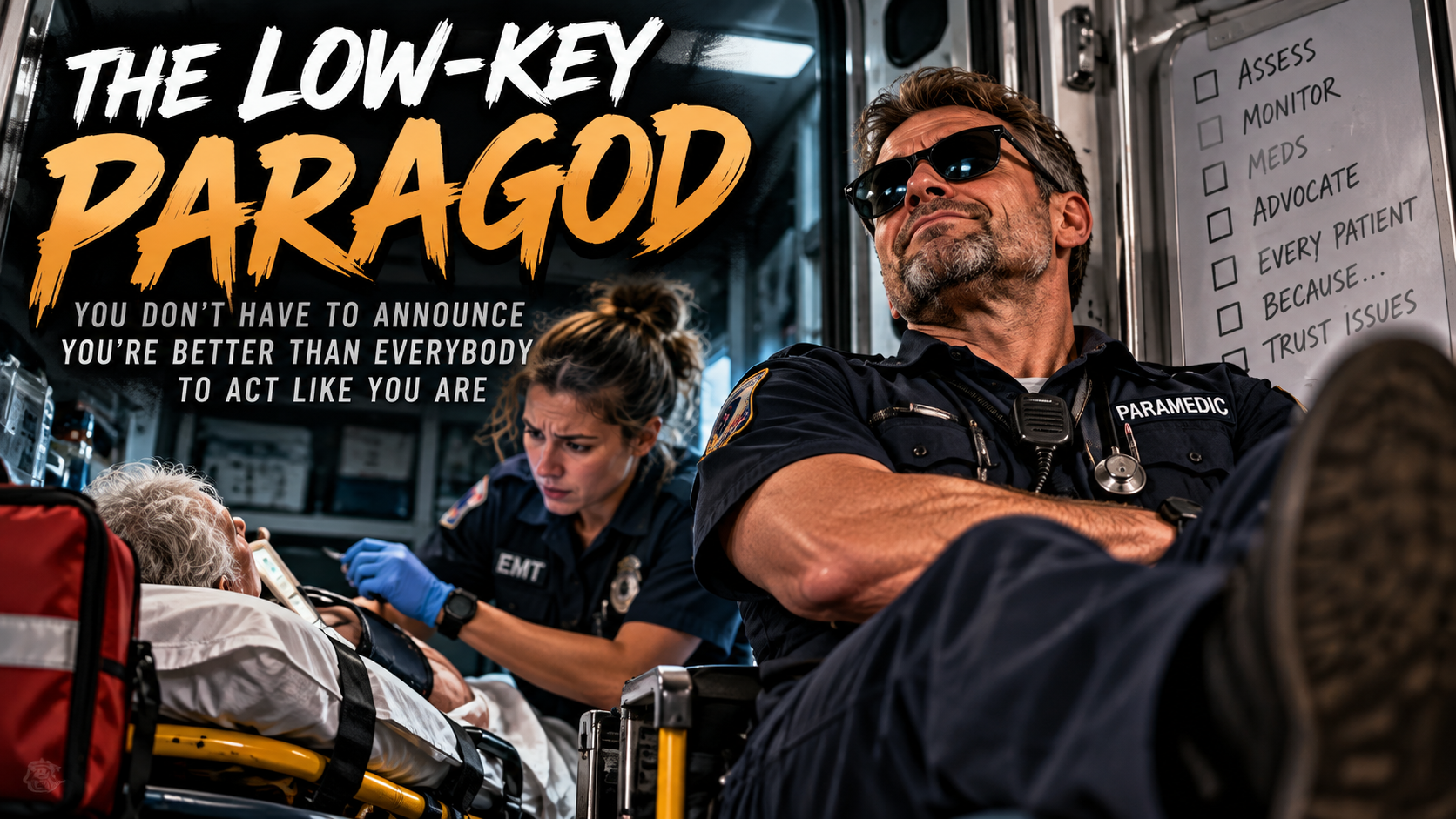
The Low-Key Paragod never announces they're the smartest provider in the room. They don't have to. They just behave like nobody else on the truck can be trusted to touch the patient.
Ask 'em about it and they'll tell you they have high standards. They're protecting the patient. They're just being careful.
And sometimes that's true.
Sometimes it's complete bullshit.
Because underneath all that careful, what they're really saying is: "I know you passed EMT school. I know you passed AEMT school. I know somebody issued you a license, signed off your competencies, and cleared you to ride this ambulance. I just don't trust you to actually take care of anybody."
But you can carry the monitor.
Grab the bags. Make up the cot. Wipe down the stretcher. Restock the truck. Hold the door. Drive.
Congratulations, partner.
You are now a highly trained chauffeur with a CPR card.
And six months later (set your watch by it) that same medic will be standing under the fluorescent lights in the ambulance bay, coffee going cold in a styrofoam cup, complaining that the EMTs and AEMTs around here "don't know how to take care of patients."
Well.
No shit.
You never let 'em.
Now think about that for a second.
Go ahead. I'll wait.
…
If the patient is legitimately BLS, let the EMT take care of the patient. If the patient fits comfortably inside the AEMT's scope, let the AEMT take care of the patient.
Now don't misunderstand me.
That does not mean the paramedic gets to disappear.
You don't hop up in the driver's seat, jam your earbuds in, and forget you've got a patient and a partner in the back while ZZ Top blasts away what little hearing you've got left.
Your brand-new EMT is back there trying to remember which end of the blood pressure cuff goes up, and you're up front playing air guitar at a red light.
You're still the senior clinician. Still part of the crew. Still paying attention.
Mentorship is not abandonment.
But mentorship also isn't snatching every patient because you can do the assessment faster.
Of course you can do it faster.
You've been doing it longer. You've seen more. Your brain finishes the pattern before your mouth finishes the first question. You've got that weird EMS radar, the one where you walk in, look at somebody for three seconds, and already know this is not the simple little transfer dispatch promised you.
Dispatch lies. That's a whole other sermon.
Point is, that radar came from experience.
And how, exactly, do you suppose your partner gets experience?
…
Taking care of patients.
Not watching you do it.
Nobody ever learned to swim from the bleachers.
That goes double for the brand-spanking-new ones.
New EMTs are new.
I know. Shocking revelation. Somebody call JEMS.
They're gonna be slower than you. They're gonna ask questions you quit asking years ago. Their assessment's gonna feel clunky, like watching somebody parallel park with an audience. They'll forget a question, remember it thirty seconds later, and circle back. They'll stare at that twelve-lead an extra beat because it hasn't turned into something their brain reads from across the room yet.
That's not incompetence.
That's learning. It's just uglier to watch.
And this right here? This is where things usually go sideways.
They hesitate. Half a second, maybe. And you jump in.
Next call, they hesitate. You jump in again.
You know what they learn?
Exactly one thing.
Wait long enough and the medic will take over.
Then we sit around the station at 2 AM wondering out loud why that kid never developed any confidence.
Confidence doesn't fall out of the sky because somebody passed a class. It gets built. Repetition. Appropriate responsibility. Decent coaching. The chance to make real decisions somewhere safe enough to survive being wrong.
That doesn't mean letting somebody hurt a patient.
It means knowing the difference between a provider who's thinking and a provider who's drowning.
From the outside, those two look a whole lot alike. Same stare. Same quiet.
But it is not the same quiet.
One's the quiet of somebody working it out.
The other's the quiet of somebody who's already gone under and doesn't know how to say so.
A good preceptor can tell which is which. Honestly, that's most of the job. The rest is paperwork and keeping your mouth shut.
So when they forget a question and circle back, let 'em.
When they pause before answering the nurse, let 'em think.
When they say, "Hang on, I want to check something again…"
Good. That right there is clinical reasoning growing in real time. Don't step on it.
You don't need to rescue them from every quiet moment.
You don't need to answer every question somebody aims at them.
And you sure as hell don't need to turn every BLS transfer into a matinee showing of How Magnificently I Obtain a History.
Stand there.
Listen.
Watch.
Coach what needs coaching. Correct what matters.
If the patient's safe, let the provider work.
And please. For the love of all that's holy and a few things that ain't.
Quit hiding behind patient advocacy every time somebody asks why your partner never gets to do anything.
Yes. Advocate for your patient. Absolutely. Every time.
But your EMT can advocate too. So can your AEMT.
Patient advocacy did not magically download into your skull the day somebody handed you a paramedic patch.
An EMT can notice Grandma's getting discharged home without the equipment she's gonna need. An AEMT can eyeball that cylinder and ask whether there's enough oxygen to make the trip. Either one can challenge an unsafe transfer, clarify a confusing report, talk to a scared family, speak up when something smells wrong, and protect a patient's dignity when nobody else in that hallway is bothering to.
That's not a paramedic skill.
That's being a decent healthcare professional.
So don't wear "I'm advocating for the patient" as camouflage for "I don't trust anybody but me."
Don't be a d-bag.
Especially with the new ones. They remember. Lord, do they remember.
Now.
Before somebody reads all this and decides Old Grumpy Paramedic just signed them a permission slip to dump every call on the EMT and go start their own private concert up front…
Let me stop you right there.
Nope.
Whew. Son… that dog won't hunt.
If the call is ALS, be the damn paramedic.
That patch comes with a bill attached. If the patient needs ALS-level assessment, monitoring, medication management, airway, anything that lives under your role, this is not the moment for a philosophical stand on delegation.
Get in there.
Same goes the other direction. If your EMT or AEMT looks at a patient and says, "I'm not comfortable with this one," you listen.
That sentence doesn't automatically mean weak. Or lazy. Or incompetent.
Sometimes knowing a patient is past your comfort level is the most responsible clinical decision anybody on that truck makes all day.
I'd a thousand times rather hear a new EMT say, "Mike, I'm not comfortable with this patient," than watch them fake it because they're scared to death somebody'll think less of them.
Honesty, we can work with.
False confidence gets people hurt. Sometimes in ways that don't show up until years later, at 3 AM, staring at a ceiling.
And while we're on the subject of things medics do that make my left eye twitch…
The downgrade game.
You get dispatched ALS. You roll up. You look at the patient. Five minutes in, here it comes:
"Why is this ALS?"
"I don't see why they needed a medic."
"This could've gone BLS."
Maybe.
Maybe it could have.
Maybe the sending facility is being extra careful. Maybe their policy requires ALS for that drip, that device, that diagnosis. Maybe somebody checked a box. Maybe that nurse knows something that hasn't made it into your report yet. And if you've been doing this long enough, you know how often that turns out to be the whole story.
Here's the part that matters.
They requested ALS.
There's a reason.
You may like the reason. You may not.
Unless there's a real clinical, operational, regulatory, or safety problem that needs fixing, quit haggling the patient downward like a used lawnmower at a yard sale just because you've decided the call is beneath you.
Don't argue.
Just do.
You got requested as the paramedic.
Congratulations.
Today you get to be one.
The real skill (the one nobody puts on a skills sheet) is knowing when to step in and when to shut up.
Being the senior clinician doesn't mean being the clinician every single time.
Sometimes leadership means stepping forward.
Sometimes it means standing beside somebody else while they do the work, hands in your pockets.
That second one's harder. Ask anybody who's ever precepted. It's like watching somebody else drive your truck.
If your EMT's interviewing the patient fine, let 'em finish. If the assessment's reasonable, let 'em work it through. If they're talking to the nurse, swallow the urge to cut in just because you'd have worded it different.
They don't need to turn into a miniature you.
God knows one of us is plenty.
They need their own rhythm. Their own way of talking to people. Their own judgment.
Your job is to help shape that judgment without owning it.
That's mentorship.
It is not a hostage situation.
Now here's the part that's gonna irritate a few folks.
Your goal should be for that new EMT or AEMT to wind up better than you.
Not almost as good.
Not "good enough to work with."
Better.
They ought to get your good habits. They ought to learn off your mistakes. They ought to cash in on the calls you screwed up twenty years ago, pick up the shortcuts that took you a decade to stumble onto, and inherit the lessons without having to collect every one of the scars.
That's how a profession gets better. Every generation hands the next one a slightly better starting line.
And if the thought of your student someday outshining you makes something deep in your ego twitch a little…
Well.
Maybe we found the real problem.
Oh. Did I hit a nerve?
Good. Sit with it a minute.
Because if you need the people around you to stay less capable so you can keep feeling important, you're not mentoring anybody.
You're guarding a throne.
And EMS has got more than enough little kingdoms already. Bless their hearts.
Here's the thing every experienced medic eventually forgets.
At some point, you sucked too.
You did. I did. All of us.
You did not walk out of paramedic school with twenty years in your pocket.
Somebody let you touch a patient.
Somebody let you take the lead.
Somebody stood quiet behind you, arms crossed, coffee in hand, while you fumbled through an assessment that took three times longer than it should have. And they didn't say a word until it mattered.
Somebody corrected you. Usually back in the truck, where nobody else could hear.
Somebody trusted you before you trusted yourself.
Some of those folks are gone now.
I think about 'em more than I let on. Mostly on the drive back to quarters, when the radio's gone quiet and the road's empty and there's nothing left to do but remember who stood behind you.
Somewhere along the line, you got competent.
Maybe even good.
Return the favor.
Let your EMT be an EMT. Let your AEMT be an AEMT. When the patient needs a paramedic, be one.
And every now and then, get your happy ass up in the driver's seat and let somebody else ride in back.
Earbuds out.
One day they'll be better than you.
That's not failure.
That's the whole damn point.
— Old Grumpy Paramedic