There are a few things in EMS that never really change.
Your patch might. Your scope might. Your truck might get more expensive. Your drug box might get heavier. You might move from an EMR bag and an oxygen bottle to ventilators, pumps, blood products, invasive lines, and enough electronic equipment to make the back of the ambulance look like a small ICU somebody shook up and put on wheels.
But some things stay the same.
And if you forget them, all the certifications in the world will not save you from looking stupid.
That brings me to three things: CSR, PMA, and the First Rule of Troubleshooting.
Before somebody starts wondering what new alphabet soup they forgot to put in the textbook, relax. This is simpler than that.
CSR: Customer Service Representative
CSR has two meanings in my world.
The first is Customer Service Representative.
Here is something that occasionally irritates EMS folks when I say it: at the end of the day, you are a customer service representative with an EMT license.
Before somebody gets their Littmann in a knot, hear me out.
You deal with customers all day long. Patients, families, nurses, CNAs, doctors, dispatchers, facilities, partners, bystanders, and receiving staff. Sometimes every one of them wants something different from you.
Your job is not just to show up, perform a procedure, haul somebody down the road, dump them in another bed, and disappear into the mist.
You are there to take care of people.
That includes how you talk to them, how you move them, how you explain what you are doing, how you answer questions, how you treat their belongings, how you respond when they are scared, and how you act when they are annoying the ever-loving hell out of you.
That last one counts too.
Good customer service does not mean the customer is always right. That phrase has caused enough damage in modern society already.
Sometimes the patient is wrong. Sometimes the family is wrong. Sometimes the facility is wrong. Sometimes everybody in the room is confidently wrong at the exact same time.
And part of your job is to explain that.
Politely. Compassionately. Professionally. Clearly.
You do not have to prove them wrong. You have to help them understand what is right.
There is a big difference between saying, “No, you are wrong,” and saying, “I understand why you are concerned. Let me explain what I am seeing and why we are handling it this way.”
Same correction. Very different result.
Sometimes excellent customer service means professionally disappointing somebody.
We are not Burger King. You do not always get it your way.
But we can still treat you like a human being while we tell you no.
CSR: Common Sense Rules
CSR also means Common Sense Rules.
Yes, I know. Common sense is apparently becoming an elective.
But in EMS, it matters.
Before you start chasing zebras through the weeds, ask yourself one simple question:
Does this make sense?
The monitor says the heart rate is 220, but the patient is sitting there calmly eating crackers and complaining that the ambulance is cold. Maybe, just maybe, you ought to look at your electrodes before you start yelling “SVT.”
The pulse ox says 72%, but the patient is pink, talking in full sentences, has warm skin, good mentation, and no obvious respiratory distress. Before you start throwing every oxygen device in the truck at them, look at the waveform. Check the probe. Move it. Warm the hand. Assess the patient.
The automatic blood pressure says 64/38.
Okay.
What does the patient look like?
Do they have a radial pulse? Are they perfusing? Are they altered? Did the cuff slide down to their elbow?
Take a manual pressure.
Technology is wonderful. Technology is also perfectly capable of lying to you.
Treat the patient, not the monitor.
That phrase has been around longer than some of the people reading this, and it remains true.
Common sense does not mean ignoring technology.
It means technology does not get to overrule the patient without being questioned.
PMA: Positive Mental Attitude
Then we get to PMA.
PMA also has two meanings.
The first is Positive Mental Attitude.
And no, I do not mean inspirational-poster nonsense.
I am not asking you to stare at a sunset and whisper affirmations while your IV pump is screaming at you.
PMA means this:
Do not let frustration shut your brain down.
Something is not working? Fine. Try something else.
The IV will not thread? Change angle, change site, change catheter, ask for another set of hands, reassess.
Cannot ventilate? Reposition. Check your seal. Check your adjunct. Look for obstruction. Change technique. Change equipment.
The ventilator is alarming? Do not immediately assume the machine has been possessed by the devil. Look at the patient. Look at the tube. Look at the circuit. Look at the oxygen source. Look at your settings. Look at secretions. Look at compliance.
Then deal with the machine.
Positive Mental Attitude does not mean pretending everything is fine.
It means maintaining enough control of your own head to say:
“Okay. That did not work. What is next?”
That is an EMS skill.
A damn important one.
PMA: Proper Medical Assessment
PMA also means Proper Medical Assessment.
Because confidence without assessment is just swagger.
And swagger has killed people.
A proper assessment keeps you from guessing.
The patient says they are short of breath? Fine. Do not decide what it is before you touch them.
Assess them.
Airway. Breathing. Rate. Effort. Lung sounds. Skin. SpO₂. Waveform. History. Onset. Position. Vitals. Trends. What changed? What makes it better? What makes it worse? What happened before you got there?
And then, this is the part some folks seem to forget, reassess.
A single set of vitals is a photograph.
Multiple sets give you the movie.
And medicine happens in the movie.
A Proper Medical Assessment gives your Common Sense Rules something to work with.
Otherwise, you are just making educated guesses with expensive equipment.
The First Rule of Troubleshooting
Now we get to my favorite part.
The First Rule of Troubleshooting.
Define the problem.
Before you start changing settings, swapping equipment, reaching for medications, or blaming the machine, figure out what is actually wrong.
That sounds painfully obvious, but watch people when something starts alarming, beeping, flashing, leaking, or otherwise acting ugly.
It is amazing how fast otherwise intelligent people can start fixing things before they have figured out what the problem actually is.
The good news is that EMS already gives us a pretty solid troubleshooting framework.
At the basic EMT level, the primary survey often defines the immediate problem in seconds.
Is the airway open? Is the patient breathing adequately? Is circulation present? Is there major bleeding? Is there an immediate life threat?
If the answer is not obvious there, the secondary survey helps you narrow it down.
That is troubleshooting.
You are defining the problem before you try to solve it.
The patient is altered.
Fine.
Why?
Start with the basics. Airway. Breathing. Circulation. Oxygenation. Glucose. Trauma. History. Medications. Environment. What changed?
That is no different in principle from what an advanced provider does.
At the ACLS level, we formalize the same thinking through reversible causes. We work through the H’s and T’s because that is another way of defining the problem.
Hypovolemia. Hypoxia. Hydrogen ion disturbance. Potassium problems. Hypothermia. Tension pneumothorax. Tamponade. Toxins. Thrombosis.
Same concept.
More advanced differential.
The H’s and T’s are troubleshooting.
They are just a structured, advanced version of the same thought process an EMT uses on a basic call.
The difference is not that the advanced provider gets to skip the basics.
The difference is that the advanced provider has a bigger toolbox.
And sometimes that bigger toolbox becomes its own problem.
Because you can be standing there working through a beautifully organized differential diagnosis, thinking about preload, vascular resistance, tamponade, electrolyte disturbance, medication effects, and every damn thing you remember from ACLS—
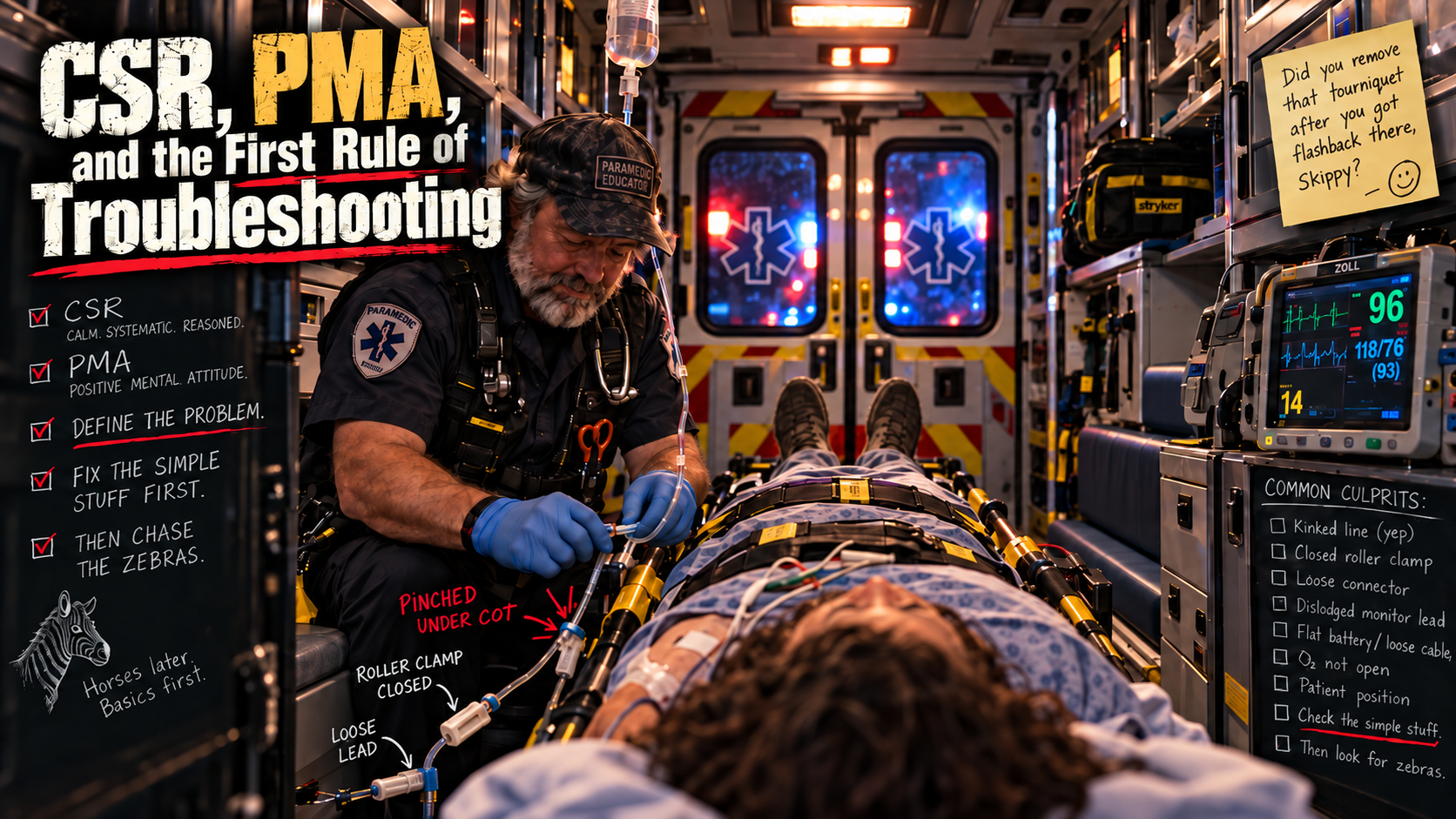
and the IV is not running because the tubing is pinched underneath the cot mattress.
That is why defining the problem comes first.
The patient suddenly becomes difficult to ventilate.
Do not immediately start turning knobs on the ventilator.
Define the problem.
Is the patient breathing? Is the airway patent? Is the tube where it belongs? Is the chest rising? Are breath sounds present? Is there an obstruction? Is the circuit intact? Is oxygen flowing?
The monitor suddenly shows a heart rate of 220.
Define the problem.
Is the patient awake? Do they have a pulse? What does the pulse feel like? Does it match the monitor? What does the rhythm actually look like? Are the leads attached correctly?
The blood pressure comes back 64/38.
Define the problem.
Is the patient altered? Pale? Diaphoretic? Do they have a radial pulse? What does perfusion look like? Does the pressure make sense clinically? Is the cuff positioned correctly? What does a manual pressure show?
Once you have defined the problem, then you can start narrowing the cause.
And yes, after you define it, start simple.
Check the obvious before you invent exotic explanations.
A kinked tube. A closed clamp. A bad connection. A dead battery. A loose electrode. A probe on the wrong finger. Wrong setting. Wrong port. Empty oxygen bottle.
Or somebody changed something and forgot to mention it.
And before we move on…
Did you remove that tourniquet after you got flashback there, Skippy?
Veteran providers do not feel stupid checking simple things.
They have seen too much stupid stuff happen to skip them.
If everything was working until somebody touched something, start with the thing they touched.
The patient was fine until the tubing was changed? Look at the tubing.
The vent was fine until a setting was adjusted? Look at the setting.
The pump was fine until the patient got moved? Look at the line.
Everything worked until somebody “helped”?
Well.
There you go.
Same Brain. More Expensive Toys.
This is where the whole thing comes together.
None of these ideas belongs to one certification level.
The EMR uses them. The EMT uses them. The AEMT uses them. The paramedic uses them. The critical care medic uses them. The flight medic uses them.
The complexity changes.
The thinking does not.
An EMR trying to figure out why oxygen is not flowing may work through the tank, regulator, tubing, device, and patient.
A critical care medic troubleshooting a ventilated patient may work through the patient, airway, tube, circuit, ventilator, gas source, and power source.
Same thought process.
More expensive toys.
That is it.
Experience should not make you jump immediately to more complicated explanations.
Experience should teach you to check the obvious first because you have lived long enough to know that the obvious fails every damn day.
And somewhere in the middle of all these acronyms, alarms, checklists, pumps, monitors, vents, protocols, and certifications is the patient.
That part matters more than everything else I have written here.
There is still a human being attached to all that equipment.
A scared one, sometimes. A hurting one. A confused one. A pissed-off one.
There may also be a family member standing three feet away convinced you are doing everything wrong because nobody has explained what you are doing.
Sometimes the clinical problem is under control. The equipment is fine. The assessment is sound. The treatment is correct.
And the real problem is that nobody has told the patient or family what the hell is going on.
Fix that too.
That is patient care.
So when everything gets complicated, remember the basics.
CSR: Customer Service Representative and Common Sense Rules.
PMA: Positive Mental Attitude and Proper Medical Assessment.
And the First Rule of Troubleshooting:
Define the problem.
Use your head. Do the assessment. Treat people well. Question things that do not make sense. Know enough advanced medicine to consider the H’s and T’s when the situation calls for it.
And have enough common sense to check whether the damn IV line is trapped under the cot mattress.
That is not “basic” medicine.
That is good medicine.
Whether you are an EMR with an oxygen bottle or a Critical Care Flight Medic surrounded by six figures worth of equipment, the job is still the same:
Figure out what is wrong.
Take care of the person.
Fix what you can.
Reassess.
And do not let the fancy toys make you forget the simple stuff.