…alright, pull up a chair a second. Coffee’s probably burnt, radio’s quiet (did he just use the ‘Q’ word?!) for five minutes, and somebody somewhere on the internet is arguing about EMS education again. Happens every week. Same fight, different comment section.
So let’s talk about it.
Higher education in EMS.
Yeah… I know. Polarizing topic. Been beaten to death in conference halls, Facebook groups, and the back of ambulances at 2 AM. But here’s one old, slightly cranky paramedic’s two cents after a couple decades on the street.
First thing—we need to get something straight right out of the gate.
I’ve known EMTs and paramedics who were absolute artists on the truck. Calm under pressure. Could walk into a chaotic scene, take one look at the patient, and just know what was wrong before the monitor even finished booting up.
And their entire academic background?
High school diploma. Certification card. Maybe a CPR instructor patch.
That’s it.
And they were phenomenal.
Meanwhile I’ve met folks with bachelor’s degrees who couldn’t talk a drunk diabetic into drinking orange juice if their life depended on it. Great with textbooks. Freeze like a deer in headlights when the scene gets loud and messy.
So no—college doesn’t magically make you a good medic.
The street does that.
It happens at 3 AM in a trailer park when dispatch swore it was “just abdominal pain,” but the patient’s gray, sweaty, clutching their chest, and the family’s shouting three different medication lists while a dog is barking like the apocalypse just started.
That’s where the real education happens.
The truck is the classroom.
Always has been.
Always will be.
With That Said
Now… with that said.
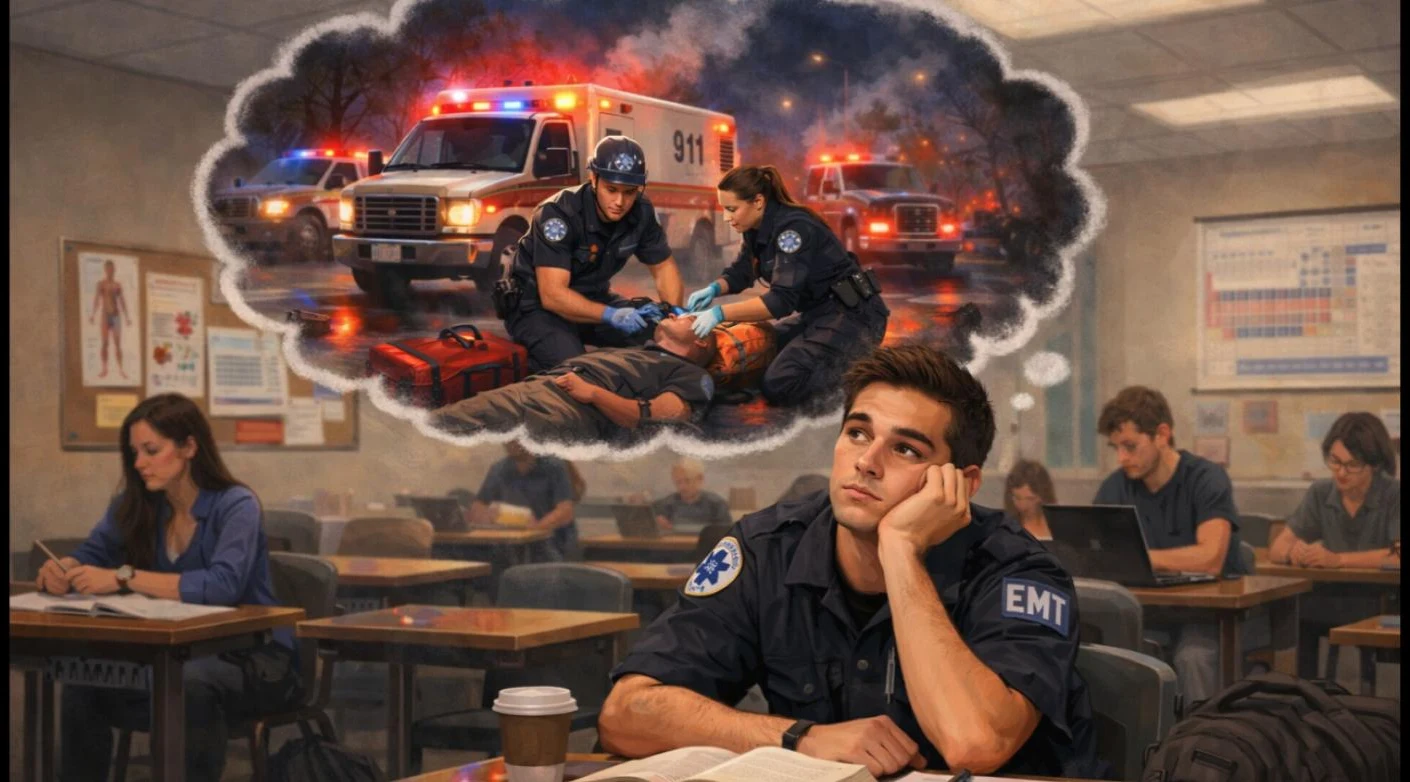
I still tell young EMTs and medics that if they can pursue higher education, they probably should.
Not because it makes you smarter.
Because it makes you better rounded as a human being.
And I know that sounds like guidance counselor nonsense, but stick with me.
Those boring core classes everyone complains about? The ones people think have nothing to do with EMS?
English composition. Public speaking. Communication. Psychology. Even the math courses.
You will use those skills every single shift whether you realize it or not.
Half of EMS is communication.
Explaining complicated medical problems to scared people who are running on adrenaline and zero sleep.
“Ma’am, your husband’s heart rhythm isn’t normal. He’s stable right now, but we need to get him checked at the hospital.”
Say it poorly and the entire family panics.
Say it clearly and calmly… suddenly the room settles down.
That’s not a medical skill.
That’s communication.
And college forces you to develop it.
Anatomy, Physiology, and the Math That Actually Matters
Then there’s anatomy and physiology.
If you’re thinking about EMS as a long-term career, take A&P. The real class. Not the watered-down “here’s a skeleton, memorize three bones” version.
Understanding how the body actually works will help you for the rest of your career.
Because one night you’ll be staring at a patient whose blood pressure is dropping, pulse is racing, skin is clammy, and something in your brain starts connecting dots.
Maybe it’s sepsis.
Maybe it’s cardiogenic shock.
Maybe the body’s plumbing and pump just stopped cooperating.
That’s when the knowledge you learned years earlier suddenly clicks.
Quick side note on math. If your college offers something like “Math for Nurses” instead of full-blown college algebra, take that.
Trust me.
You’re not solving theoretical equations in EMS.
You’re calculating medication doses while bouncing down a pothole-ridden road with a combative patient yelling in the background.
Different skill set entirely.
The Piece Most People Miss
But here’s the piece most people miss when they argue about degrees.
Higher education isn’t just about knowledge.
It’s about discipline.
When an employer looks at a degree, what they’re often seeing isn’t just the coursework.
They’re seeing proof that someone started a long, difficult process…
…and finished it.
Think about it.
Working EMS shifts. Studying at night. Writing papers. Taking exams. Showing up to class when you’d rather be sleeping after a 24-hour shift.
And still grinding through two or four years of school.
That kind of follow-through says something about a person.
Not that they’re smarter.
But that they’ve got grit.
They finish what they start.
That matters.
Especially if you ever want to move beyond the truck.
Teaching. Leadership. Administration. Program direction. Quality improvement.
Many of those roles require a degree—not because the knowledge magically makes you a better medic, but because the positions involve skills beyond patient care.
Writing reports.
Designing training programs.
Interpreting data.
Speaking in front of committees and hospital boards that barely understand what EMS even does.
That’s where those college courses start pulling their weight.
Even the structure of EMS education itself reflects that kind of disciplined thinking. State psychomotor examinations require providers to methodically move through scene size-up, primary assessment, patient history, and reassessment in an organized sequence.
It’s not about memorizing boxes.
It’s about learning to start a process and finish it correctly.
Same mindset that gets someone through a degree program.
EMS Is Customer Service With an EMT License
And here’s a funny truth most people don’t realize until they’ve been in EMS a while.
If you came from customer service—restaurants, retail, hospitality—you already have a major advantage in this profession.
Seriously.
Because once you strip away the lights and sirens, the fancy medical gear, the adrenaline stories…
We show up when people are having the worst day of their lives.
Our job is to stabilize the situation—not just medically, but emotionally.
That means reading people. Calming families. Dealing with angry patients. Defusing tense situations.
A veteran waitress who’s survived a Friday night dinner rush can often walk into EMS and thrive.
Same skill set.
Different uniform.
The Bottom Line
So here’s the bottom line.
You do not need a college degree to be a great EMT or paramedic. Some of the finest street providers I’ve ever worked with never set foot in a college classroom.
But if you have the opportunity to pursue higher education, it can absolutely benefit your career.
Not because it magically makes you a better medic.
But because it helps shape you into a more capable professional—and it proves to future employers that you have the discipline to take on something difficult and see it through to the end.
And in a profession where persistence, resilience, and follow-through matter every single shift…
That’s not a small thing.
My coffee’s cold, the radio just toned out another “unknown medical,” and if history tells me anything it’s either a life-threatening emergency or a guy who ran out of cigarettes.
EMS roulette baby! Time to roll the dice again.