Two kinds of providers walk into my orientation class.
On one side you’ve got the brand new ones — ink still wet on their EMT license, eyes wide, notebooks open. Scared stiff and trying not to show it. On the other side you’ve got the veterans — medics and EMTs who’ve seen everything, done everything, and have quietly decided that IFT transport is beneath the application of everything they know. They’re here for the extra check. Play money. Alimony. Take your pick.
Neither one of them really wants to be there.
And both of them are already wearing it on their face before I say word one.
Reading the Room, Every Time
Here’s the thing about thirty-six years in EMS. It rewires you whether you asked it to or not. And it doesn’t ask permission.
Every provider learns early — you read the scene before you touch it. You walk through that door and before you open your mouth or pop the jump kit you’re already running the assessment. Color. Posture. Eye contact. The thing the body is doing that the mouth hasn’t said yet.
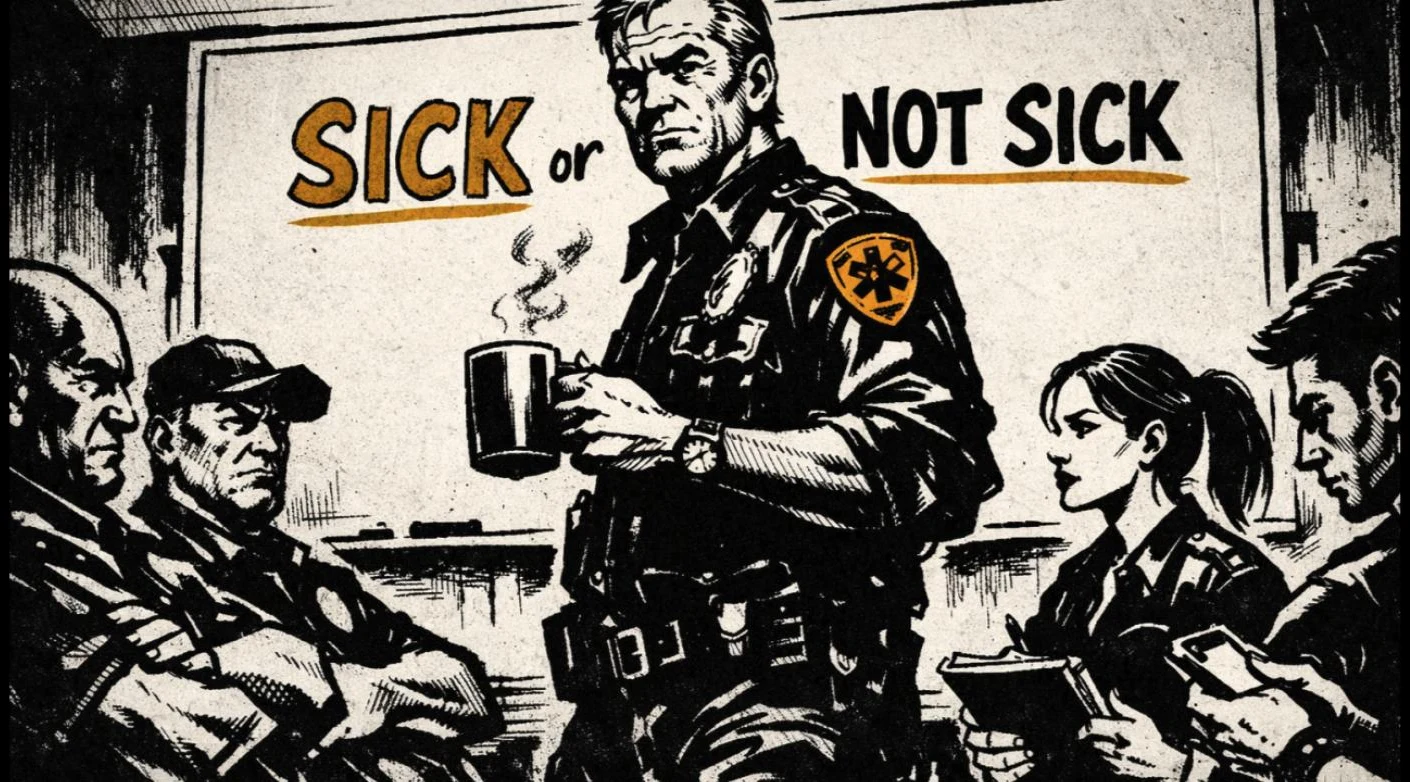
Sick or not sick.
Takes about three seconds. Maybe less. You don’t think about it anymore. It just happens.
I walk into that conference room doing the exact same thing. Different scene. Same eyes. Same instinct that kept me alive and kept my patients alive for three and a half decades on the street.
And what I see most mornings is a room full of people presenting as not teachable.
Which means my job just got interesting. Again.
To the New Ones. Bless Their Hearts.
Let’s start with the new ones. Bless their hearts.
Fresh license. Clean uniform. Boots that still have that straight-out-of-the-box shine that’ll be gone in a week if they’re paying attention.
They’ve got the pretense of eagerness and attentiveness. Doesn’t make it to the eyes though. Because behind those eyes they’re already somewhere else — parked outside a 911 station, mentally, waiting for their real life to begin.
Let me save you some time kid.
IFT isn’t the waiting room for the real job. It’s the laboratory. It’s where you learn to actually talk to a patient when there’s no emergency eating all the oxygen in the room. Where you build the documentation habits that won’t embarrass you on your first 911 shift. Where you figure out your own hands before the chaos sorts that out for you on a cardiac arrest at 2am in a bar bathroom.
The 911 system will still be there. I promise. It isn’t going anywhere.
But the provider who comes up through IFT with their fundamentals locked in — that’s the one I want next to me when things go sideways. Not the one who was in such a hurry to get to the fast stuff that they skipped the slow work entirely.
What Nobody Puts in the Textbook
Here’s what nobody puts in the textbook.
Affective skills. The human ones. The ones that only come with time and reps and enough humility to know you don’t have them yet.
New providers — I hear you on the radio. I watch you do your assessments. And sometimes it sounds like you’re reading from a script nobody gave the patient a copy of. Chief complaint. Onset. Duration. Provocation. Quality. You’re hitting every box on the form and missing the actual human being in front of you.
Stop box checking. Start listening.
Talk TO your patient. Not AT them. There’s a difference and they feel it immediately.
Ask them how they’re doing like you actually want to know the answer. Sit with the silence for a second after they respond. Let them finish the sentence. Because here’s what thirty-six years taught me that no curriculum ever could —
Your patient will tell you exactly what’s wrong if you give them half a chance to do it.
They’ve been waiting for someone to actually listen.
Don’t be a box checker.
Be a clinician.
Now. The Veterans.
Oh the veterans.
You walked in here with your arms already crossed. I saw it. Don’t act surprised — remember what I said about reading a scene. You’ve run codes, worked traumas, delivered babies in parking lots at midnight. You’ve got miles on you and scar tissue to prove every single one of them.
And IFT feels like a step backward from all of that. I understand. I genuinely do.
But don’t think the box checker conversation doesn’t apply to you too. You’ve got the active listening skills. You’ve earned them the hard way over years of calls that would make a new provider’s hair stand up.
Use them.
Don’t let familiarity turn into autopilot. Don’t let reps turn into routine. The minute you stop actually hearing your patient is the minute you become a very expensive box checker with a patch on your shoulder and a whole lot of years that should’ve taught you better.
That patient in the transport van — the elderly woman going from the skilled nursing facility to dialysis for the third time this week — what does she deserve from you?
Same thing every patient deserves.
Your full attention. Your best assessment. Your complete professional standard. Not the dialed-down phoning-it-in version of you that checked out mentally because the call didn’t come with lights and sirens and an audience attached to it.
She doesn’t know you’re slumming it. She just knows whether or not you actually saw her.
And here’s the thing about patients that never changes no matter how many years you’ve got on that patch.
They always know.
So check the attitude at the door. Or better yet — leave it in the car where it belongs.
Slow Is Smooth. Smooth Is Fast.
This is why IFT matters in ways the EMS world doesn’t talk about enough.
Not because the calls are glamorous. They aren’t. Not because anyone’s making a highlight reel of convalescent transports. They aren’t.
But because this is where you learn to be smooth before the fast shows up and expects you to already know what you’re doing.
Slow is smooth. Smooth is fast.
You’ve seen it on the t-shirts and the challenge coins and the coffee mugs. But IFT is where you actually learn what it means. In real time. With real patients. At a pace that lets you absorb it instead of just survive it.
That’s not nothing. That’s everything.
In EMS we have a saying about scene assessment. You don’t walk away because the patient looks sick.
That’s exactly why you stay.
I walked into that conference room. I read the scene. I saw what I saw.
And I stayed.
Same room. Same job. Same standard.
The only difference is the address.
Where I Land
So here’s where I land.
To the new ones — welcome. Genuinely. We love that you’re here and we need you here. But learn this early and learn it well.
The patient didn’t read the textbook.
They didn’t get the memo about presenting correctly. They don’t know they’re supposed to have a chief complaint that matches the paperwork. They’re just sick, scared, or somewhere in between — and they’re counting on you to figure it out.
And that manila folder the transferring facility sent with them? Every answer you need is in there. Open it. Read it. Revolutionary concept I know.
To the veterans — I mean this sincerely — I applaud your staying power. This job chews people up and spits them out and you’re still standing. That counts for something. That counts for a lot.
But if you’re rolling in here after a 24 hour shift ready to give half your effort to patients who deserve all of it —
That door you came in goes both ways.
I may be old. I may be grumpy. But I’m still a paramedic.
Don’t make me come out there and show you how it’s done. I’ll throw my back out and you’ll get embarrassed by an old grumpy paramedic.
Nobody wants that.