
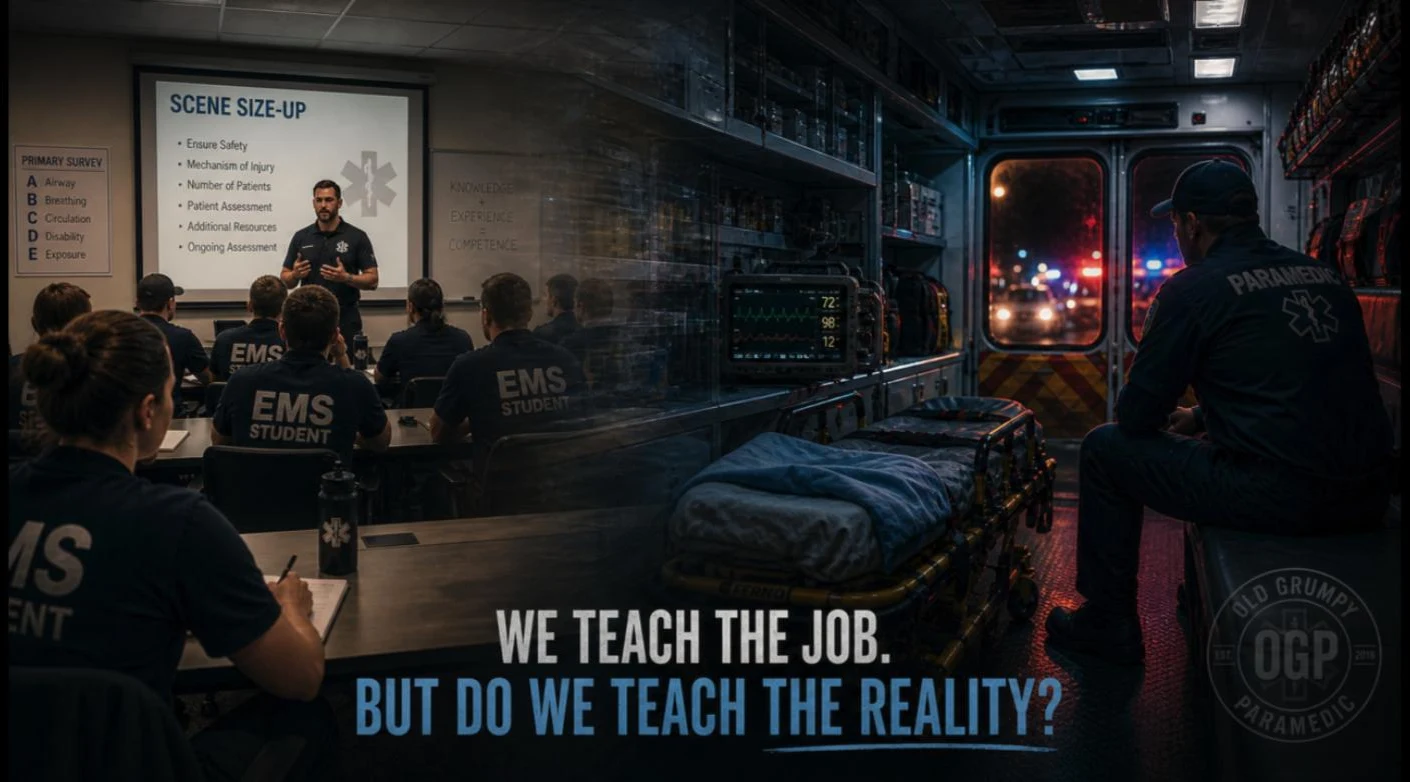
We’ve gotten good at building instructors who can teach the job on paper. But when students start asking the questions that don’t have clean answers… what are we really giving them?
So You’re Qualified to Teach That, Huh?
I want to ask you something. Not to be a jerk about it — well, maybe a little — but it’s a question that’s been sitting on my chest for a while now, and I figure somebody ought to say it out loud.
Are you actually qualified to teach what you’re teaching?
And before you point at the wall, hear me out. I see the wall. I can read. Impressive stuff. Took time to get all that. I’m not saying it didn’t. What I’m asking is something a little more specific than whether you can pass a test.
I’m asking what happens when a student — three weeks into their field internship, still green, still scared, still figuring out which pocket the shears go in — stops you after class and says:
“Hey… how do you deal with it after a bad pediatric call? Like… how do you actually go back on shift after that?”
What do you tell them?
Because if the answer you’re reaching for came from a journal article and not from standing in a driveway at 0300 with your hands still shaking, trying to figure out where to look when a parent asks you if you did everything you could — that student is going to know.
They may not say so. They’re polite. They’ll nod and write it down.
But they’ll know.
The Other Side of It
Now look — I’ve seen the other side of this too, and I’ll be fair about it. A great paramedic doesn’t automatically make a great instructor. I’ve watched twenty-year veterans get handed a laser pointer and completely fall apart. Can’t construct an objective. Can’t facilitate a discussion without turning it into their personal highlight reel. Can’t meet a student where they are because they forgot what it felt like to not know things.
Time on the box doesn’t transfer straight into the classroom.
That’s real.
There’s an old saying — those who can’t, teach. It’s been aimed at educators for generations, usually by people who’ve never tried to stand in front of a room full of tired medics at 0800 and make capnography interesting. It’s a cheap shot, and mostly unfair.
But in EMS, I think we’ve got a version of our own that nobody wants to say out loud:
Because there are parts of this job that don’t live in a textbook. They live in the specific silence after a code you called. In the way your hands feel on the drive back to the station. In the answer you give — or can’t give — when a parent grabs your sleeve in a parking lot.
You can describe that. You can build a slide about it. You can cite it.
But there are parts of this job you can only teach from memory, not from material.
A Thought Experiment
Here’s a thought experiment. Two instructors.
First one: two years on the street as a paramedic, master’s degree in education, knows how adults learn, knows how to build a curriculum, checks every institutional box there is.
Second one: twenty years on the box, associate degree in applied science, one weekend seminar on adult education basics — the kind where they feed you cold sandwiches and hand you a certificate at the end.
Who wins educator of the year?
Probably the master’s degree. The rubric says so. The resume says so. The promotion committee says so.
But who do the students come back to — years later, after they’ve been on the street long enough to know what they didn’t know — when they want to talk through a call that’s still bothering them?
I’ll let you sit with that one.
Because this isn’t really about who’s the better person or who worked harder to get where they are. It’s about what students actually need versus what institutions are designed to recognize and reward.
Those two things are not always the same thing.
In EMS, they’re often not even close.
What It Costs
But here’s what we don’t say nearly as much: time in the classroom doesn’t transfer straight onto the box either. And when you’re standing in front of people who are about to go work in the field — the real field, not a simulation lab, not a case study, the actual street — they deserve an educator who has some honest answer to the question:
How did you handle that?
Students know the difference. They hear it in your voice. They see it in your face. They feel it in the way your whole body shifts when you’re not teaching anymore — you’re remembering.
And in that moment, you don’t just explain the job.
You take them there.
Borrowed experience doesn’t do that. It can’t.
And it’s not just the bad calls.
It’s the quiet ones too — the ones where everything goes right. No fanfare. No recognition. Just a look from a family member that tells you they trust you, and a ride back to the station where nobody has to say a word.
You don’t get that from a textbook either.
Because sooner or later, every student stops asking what’s on the test—
—and starts asking what it costs.