A field guide for EMS providers who know better—and need to act like it.
Nah, see, here’s the part nobody wants to say out loud—
It’s not that you don’t know better. It’s that you’re getting comfortable being mediocre.
Yeah. I said it.
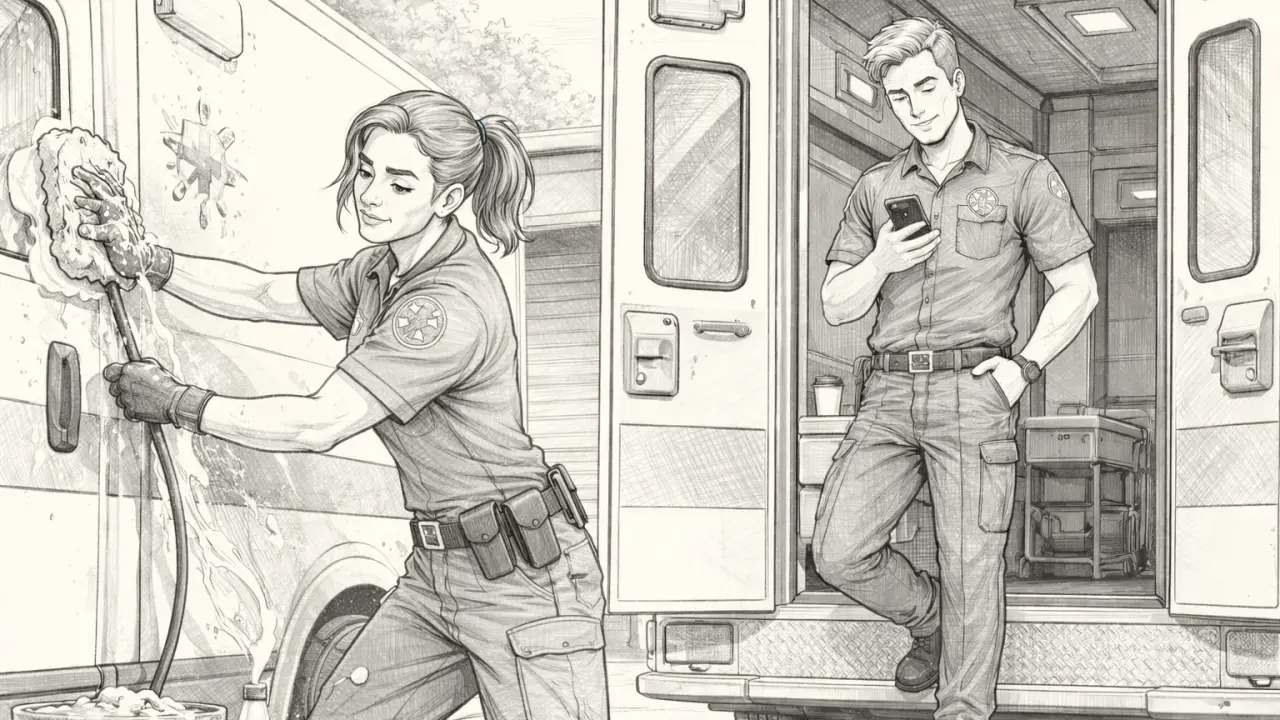
You’re in the front seat, phone glowing in your face like a damn campfire, thumb just flick-flick-flick... meanwhile your partner’s outside doing the real work. Checking the airway bag, making sure the suction actually works this time, not like last shift when it sounded like a possum choking on gravel.
And you’re in there watching... what? Some dude slipping on ice? Another cat video? Same recycled garbage.
C’mon.
The Science You Can’t Ignore
And here’s what makes it worse—it’s not just about manners. It’s not even about work ethic, though yeah, that too. There’s actual peer-reviewed research sitting behind what I’m about to say, and it is not flattering.
The scroll is engineered to hook you.
Research published in 2025 identified what scientists are now calling “dopamine-scrolling”—a distinct behavioral pattern where small doses of dopamine fire with every swipe, paired with variable reward schedules that mirror the same mechanics as slot machines. The apps aren’t designed for entertainment. They’re designed for dependency. And a study tracking 500 users over six months found those spending more than two hours a day scrolling showed a 35% drop in prefrontal impulse control.
That’s the part of your brain that makes snap decisions on scene. The part you need when the room goes sideways.
So when you’re deep in that spiral and tones drop, you’re not “snapping back to focus.” You’re starting behind.
Your working memory doesn’t have a toggle switch.
A 2024 systematic review on cognitive load in EMS found that increased cognitive load directly reduces clinical performance—and potentially leads to worse patient outcomes. Here’s the part that hits hard: working memory can hold information for roughly twenty seconds before it’s gone unless you’re actively using it. Twenty seconds. That’s one TikTok cut. So when your partner calls your name from outside the rig and you’re mid-scroll, your brain isn’t ready.
It’s still processing a video of someone’s golden retriever.
Your brain doesn’t flip to “medic mode” on command. It has a ramp-up time. And patients don’t wait for your ramp-up.
“The effects of cognitive load could be reduced through task-relevant information focus, anticipatory behaviors, and shared mental models.” — Zaphir et al., 2024
Read that again. Anticipatory behaviors. That means thinking ahead. Staying ready. Not playing catch-up because your head was somewhere else.
The Call That Made Me Think
I had a partner a few years back—kid reminded me of half the rookies now. Smart, but... distracted. Always scrolling. Always “just a second.”
We get a respiratory call. Dispatch says “difficulty breathing,” which—yeah, could be anything from anxiety to “start digging the grave.”
We walk in and the air hits you first. You know the smell—humid, sour, like illness just hanging in the room. Patient’s tripoding, lips starting to go that dusky blue. Bad. Real bad.
I’m already moving—bag, O2, thinking ahead—
And he’s a step behind. Not dumb. Just... slow to engage.
Later he tells me, “I didn’t see it coming that fast.”
Yeah. That’s because your brain was still back in whatever video you were watching.
The Phone Is Not the Problem. You Are.
Now—look—I ain’t anti-phone. Hell, I carry one. I use it every shift. Protocols, drug calcs, quick refreshers before we roll in hot. Smartphones have genuinely become essential tools for first responders—shortening response times, increasing adaptability, filling a role that used to belong to the radio.
That thing can make you dangerous—in a good way—if you use it right.
Pull up something from JEMS or EMS1. Not for an hour. I’m not asking you to become some overnight EMS guru.
Five minutes.
That’s it.
Read one article. One weird case. One “hey, didn’t know that” nugget.
Because that little nugget? That’s the thing that pops into your head later when the room goes sideways.
Your brain is literally wiring itself right now.
Neuroscience on habit formation shows a measurable shift in brain activation from the prefrontal cortex—deliberate, conscious decision-making—to the basal ganglia—automatic, near-instant response—after roughly 8 to 12 weeks of repeated behavior. What that means in plain English: whatever you’re doing consistently in the quiet moments is getting baked into how you automatically respond under pressure.
The experts call it “deliberate practice.” Research confirms years of experience alone predict performance weakly. The quality and intentionality of how you spend your downtime? That’s the real predictor.
If your default is distraction... guess what shows up on scene?
If your default is curiosity, readiness, giving a damn? That shows up too.
The Burnout Nobody Admits To
And yeah, all that “basic” stuff they hammered into you—the checklists, the psychomotor sheets, the boring repetition—that’s your foundation. Scene safe, gear ready, reassess, don’t miss the obvious.
That stuff isn’t busywork. That’s survival.
You skip it now, you’ll skip it later when it actually matters.
Over half of EMS providers are burning out right now.
A 2024 study found more than half of EMS clinicians screen positive for occupational burnout. And here’s where it connects back to you sitting in that rig: burnout doesn’t just look like exhaustion. Research documents it as disengagement—loss of commitment to the job. The slow erosion of giving a damn. When you tell yourself “I deserve to check out,” understand—that might not be rest talking. That might be the beginning of the slide. And the downstream consequence isn’t just about you.
There’s a documented relationship between provider burnout and increased medical errors and compromised patient safety.
And listen... this ain’t me just yelling at you from the crusty old medic throne.
I’ve been that guy.
Burned out, sitting in the rig, staring at my phone like it owed me money. Telling myself, “I deserve a break.”
And yeah—you do.
But there’s a difference between taking a breath... and checking out completely.
One makes you better. The other makes you dangerous.
What to Actually Do About It
So here’s the deal, rookie—or hell, you seasoned providers who should know better:
Next time you reach for your phone, just pause for half a second.
Ask yourself: “Am I using this... or hiding in it?”
Here’s what using it right looks like:
- Pre-call brain warm-up. Before you get toned out, spend five minutes with something clinical. JEMS, EMS1, Medscape, even a quick drug card review. You’re not studying. You’re priming the pump. Athletes call it activation—you’re just doing it for your brain instead of your legs.
- Make the truck check a ritual, not a chore. Go through it like you mean it. Every shift. Suction works? Check. Airway bag staged right? Check. Narcs counted? Check. The repetition isn’t administrative—it’s building the automatic behaviors that protect your patient when your hands are full and your brain is on fire.
- Bookmark one resource. Use it. Pick one: JEMS, EMS1, PubMed’s EMS filter, or even a good EMS podcast on your commute. One source. Read it or listen to it during genuine downtime—not when your partner needs you, not when the truck needs checking. Intentional downtime.
- Do the verbal run-through on scene approach. While you’re rolling in, talk through what you’re expecting. Out loud, or in your head—doesn’t matter. “Dispatch says respiratory. Could be COPD flare, CHF, PE, anxiety. What do I look for first? What do I need ready?” That mental rehearsal is deliberate practice happening in real time. It works.
- Set a scroll boundary. Pick a time window for your personal phone—end of paperwork, post-meal, genuine downtime. Research backs this: intentional usage windows significantly reduce the automatic reaching-for-phone behavior that sneaks up on you. You’re not eliminating the phone. You’re taking back control of when it gets your attention.
- Debrief—even informally. After a call that went sideways, or even one that went well, spend two minutes with your partner. What did you see first? What made you move? What would you do differently? This is the feedback loop that converts experience into expertise. Without it, you’re just accumulating time, not skill.
Then—then—go ahead and watch your stupid videos. Laugh a little. We all need that.
Just don’t let that be the only thing you’re good at.
References
- Zaphir, J. S., Murphy, K. A., MacQuarrie, A. J., & Stainer, M. J. (2024). Understanding the Role of Cognitive Load in Paramedical Contexts: A Systematic Review. Prehospital Emergency Care, 29(2), 101–114.
- Sharpe, B. T., & Spooner, R. A. (2025). Dopamine-scrolling: a modern public health challenge requiring urgent attention. Perspectives in Public Health.
- Modern Day High: The Neurocognitive Impact of Social Media Usage. (2025). PMC.
- McGarry, E., & O’Connor, L. (2024). Assessing burnout rates and contributing factors in emergency medical services clinicians. Journal of Workplace Behavioral Health, 39(3), 288–301.
- Crowe, R. P., et al. (2020). The Association of Job Demands and Resources with Burnout among Emergency Medical Services Professionals. Journal of the American College of Emergency Physicians Open, 1(1), 6–16.
- Duarte, J., et al. (2019). Influence of Burnout on Patient Safety: Systematic Review and Meta-Analysis. PMC.
- My Brain Rewired. (2025). What Drives Habit Formation in the Mind?
- Ericsson, K. A., et al. (2019). Deliberate Practice and Proposed Limits on the Effects of Practice on Expert Performance. Frontiers in Psychology.
- Verizon Frontline / Lexipol. (2021). Report: First Responders Use Smartphones More Than Mobile Radios. Smart Cities Dive.
- Pacific Northwest National Laboratory. (2016). Attention and Situational Awareness in First Responder Operations. PNNL-25158.