By Mike Doss | Old Grumpy Paramedic | Training and Education Coordinator
There is a conversation happening inside EMS that nobody wants to have out loud. It lives in the break room and the back of the ambulance and the quiet frustration of every training officer who has ever watched a highly credentialed provider not realize; they don’t know what they don’t know. It gets whispered but rarely written down.
Consider this me writing it down.
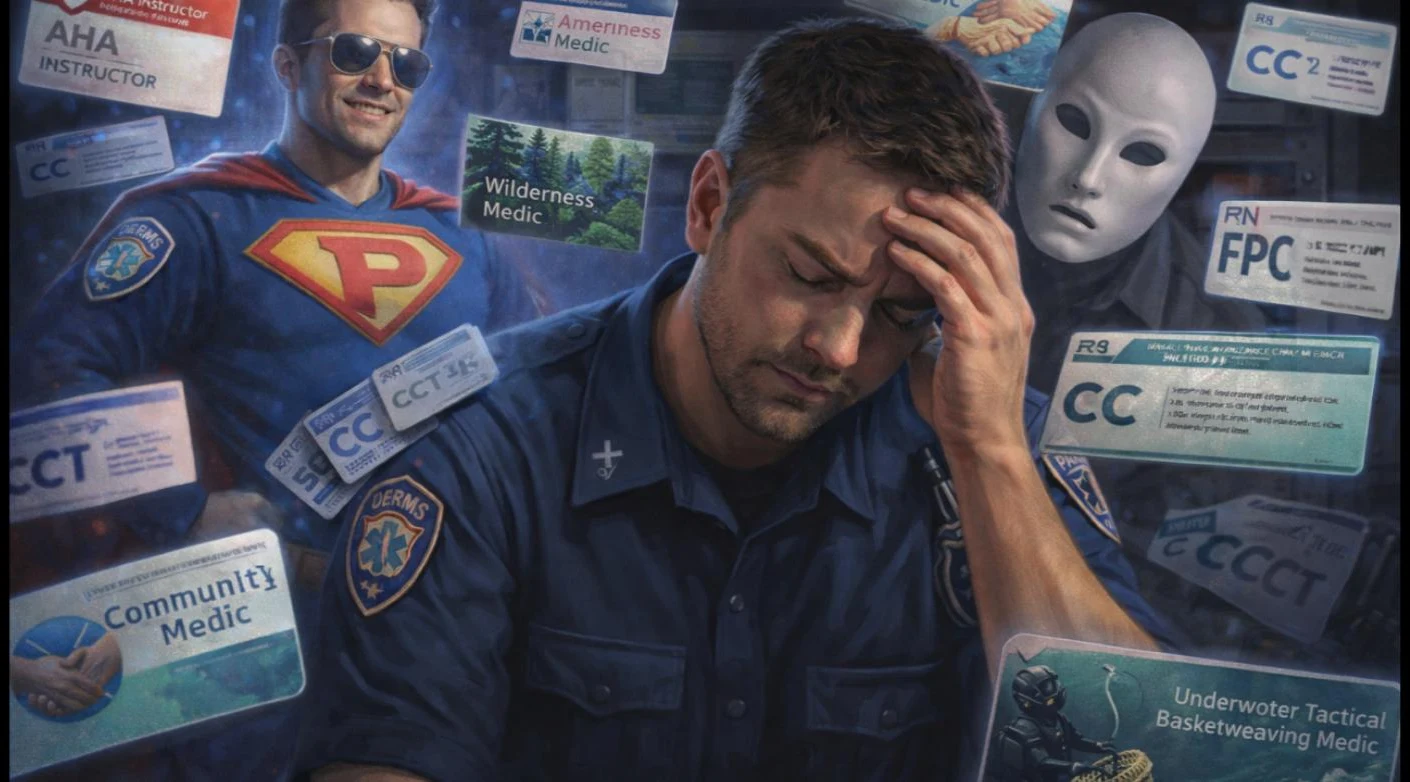
We have built a credentialing culture. Certifications are accessible, affordable, and infinitely stackable. A motivated person can spend a series of weekends in a classroom and emerge with initials behind their name that once took years of field time to justify. Critical Care. Flight. Tactical. Wilderness. AHA instructor certifications across every discipline. Each one representing a course completed, a test passed, a check written.
Each one representing exactly that. Nothing more.
I want to be clear about something before this lands wrong. Education matters. Curiosity matters. The drive to better yourself in this profession matters enormously. If you are chasing knowledge I am never going to tell you to stop. The problem is not the credential itself.
The problem is what we have allowed the credential to mean.
Somewhere along the way EMS began confusing the invitation with the arrival. A certification is an invitation — an opening of a door, an introduction to a body of knowledge, a beginning. It is not a destination. It is not a qualification. And it is absolutely not a substitute for the thing that cannot be taught in any classroom anywhere at any price.
What the Classroom Cannot Give You
It cannot give you pattern recognition. The ability to walk into a room and know — before you can articulate why — that something is wrong. That the patient who looks stable isn’t. That the scene that looks safe isn’t. That feeling does not come from a textbook. It lives in your nervous system and it was installed there one call at a time over years of showing up.
It cannot give you calibrated confidence. The kind that knows exactly where its own edges are. This is the thing I want every young provider and every person considering this career to hear clearly — the most dangerous practitioner in any EMS system is not the one who knows too little. It is the one who knows a great deal on paper, with minimal time on the unit and minimal reps in real chaos. Because that person has just enough confidence to be catastrophic. And not enough experience to know it. They do not know what they do not know. And the field has not yet shown them.
It cannot give you presence. The ability to be the calmest thing in a room that is completely falling apart around you. That is not a concept you can learn. It is a capability that gets installed through exposure. Through repetition. Through having been genuinely terrified on scene and making the right call anyway. Through surviving the call that didn’t go the way the algorithm said it would and carrying that lesson into the next one.
To the Educators, the Veterans, and the Ones Just Starting
For the educators and training officers reading this — you already know. You have watched providers arrive with impressive paperwork and underwhelming judgment. You have built curricula and written standards and sat in rooms with people who could ace your written exam and could not read a sick patient across a room. You are not imagining the gap. The gap is real and it is widening as credentialing becomes faster and cheaper and more accessible.
For the veterans reading this — you earned something that has no certificate. The ability to know what you know and know what you don’t. The humility that only comes from having been shown your own limits by a call that didn’t care about your qualifications. That is not nothing. That is everything. Do not let the culture tell you otherwise.
For those of you standing at the beginning of this career, considering your path, weighing your options — hear this as the most important career advice anyone in EMS will give you. Get in the field. Get reps. Work the calls that scare you. Sit with the discomfort of not knowing enough yet. Chase the experience as hard as you chase the certifications. Harder. Because the classroom will always be there. The calls that build you are happening right now whether you are on them or not.
The certificate says you were present for the invitation.
Time on the unit says you showed up.
The Moment No Class Prepares You For
We can teach Delivering Bad News. We can run you through PALS and NRP until you can recite the algorithms in your sleep. We can hand you the cert and shake your hand and send you to the field.
And then a mother is going to hand you her infant.
And she’s going to look at you with hope. With begging. With everything she has left.
And you’re going to know there is nothing to be done.
That moment is the curriculum.
And you don’t pass it in a classroom.
You don’t earn it at all.
It earns you.