What the Numbers Say — and What Three Decades in EMS Taught Me to Do About It.
I have been doing this long enough to remember when a new provider showed up, kept their mouth shut, watched how things were done, and earned their place one shift at a time. No handbook. No ceremony. No recognition program. You figured it out or you didn’t last. The job filtered people the way a drain filter catches debris — fast, indifferent, and without apology.
I was proud of that system. I believed in it. I came up through it. I ran calls on it for the better part of three decades.
Then I traded the rig for the classroom. And the culture shock of that transition — from street-level provider to Training and Education Coordinator — turned out to be the most useful continuing education I never signed up for.
I was also, as it turns out, wrong about a few things. Not about the standards — those haven’t moved and they never will. What I was wrong about was believing that the system that built me was the only system that could build anyone else.
The data eventually made the argument I wasn’t willing to make for myself.
The Numbers Are Ugly, and We Need To Own Them
Let us dispense with the comfortable fiction that EMS turnover is just the nature of the business.
According to the American Ambulance Association’s annual industry survey, voluntary turnover rates among full-time EMTs have run as high as 36%, with paramedic turnover sitting around 27% (AAA, 2022). A peer-reviewed study published in JACEP Open confirmed weighted agency-level turnover rates ranging between 20% and 30% annually across the private EMS sector (Panchal et al., 2023). The 2023 EMS Trend Report, drawing on more than 3,000 respondents, found that career development and advancement — not just pay — had emerged as a critical retention factor, ranking higher than in any prior survey year (Pulsara, 2023).
Read that last sentence again. Career development. Advancement. In EMS.
For a field that has historically operated on the implicit promise that longevity is its own reward, that finding should land somewhere between uncomfortable and urgent. It landed that way for me.
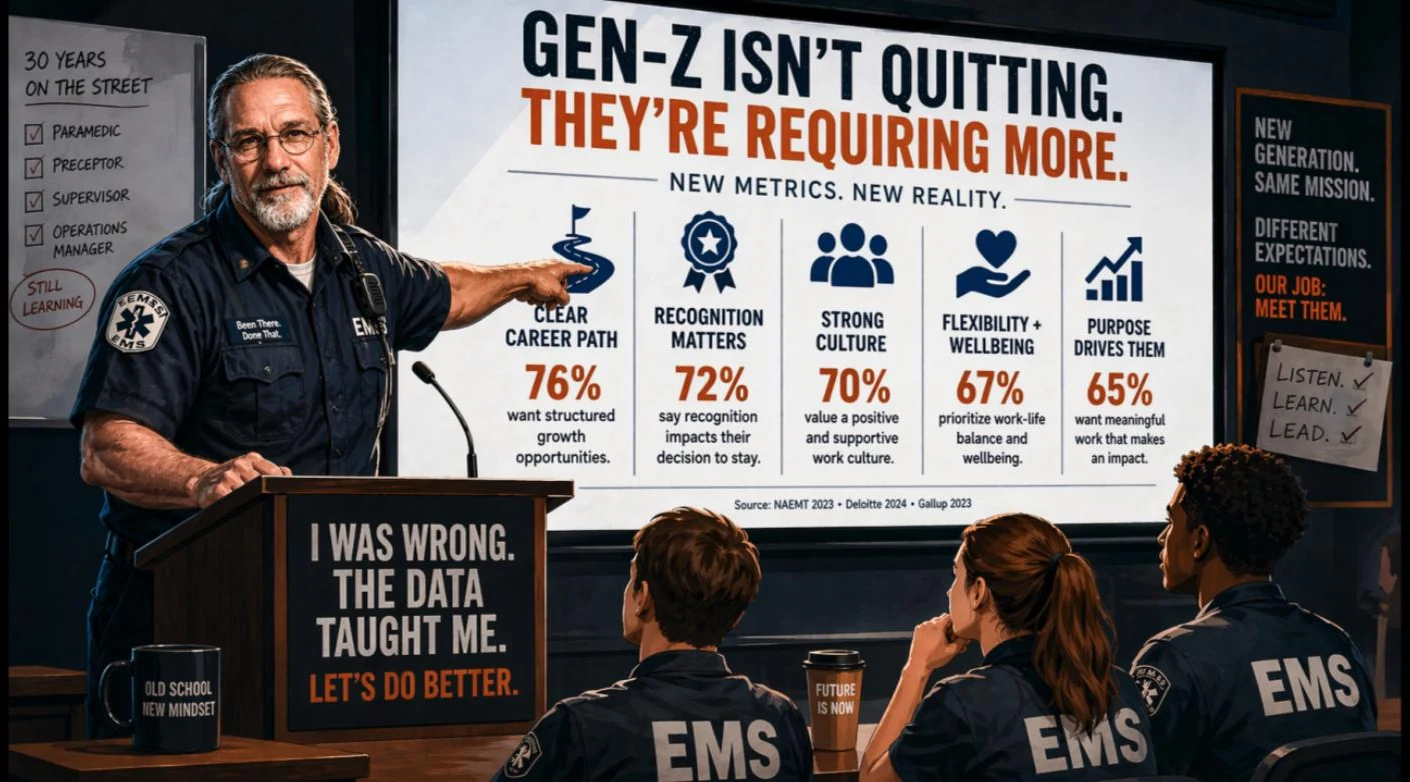
The workforce currently coming through our doors is not the workforce that built this industry. As of the second quarter of 2024, Generation Z comprised 18% of the U.S. labor force — a share that is only going to grow, with projections placing them at 30% of the total workforce by 2030. These are the providers we are hiring right now. These are the providers we are losing.
And we are losing them in a specific window — somewhere between month six and month eighteen — right after they have figured out the job and right before they have been given a reason to stay.
What I Had to Unlearn First
My first instinct, every time a good provider walked out the door, was to tell myself the story that old EMS guys tell themselves: they didn’t want it bad enough. The job is hard and some people aren’t built for it.
That story felt true. It also let me off the hook for asking harder questions.
The harder question was this: what exactly were we offering someone who was built for it?
A paycheck. A schedule. A supervisor who noticed when something went wrong. The vague institutional promise that sticking around would eventually pay off in some undefined way. That is not nothing. But for the providers coming through the door right now, it lands somewhere between insufficient and invisible.
When I moved off the street and into an education and training role, I expected the hardest part to be the paperwork. It wasn’t. The hardest part was sitting across from providers who were clearly capable, clearly committed, and clearly running out of reasons to stay — and realizing that the system I had believed in my entire career had nothing to say to them. No map. No milestone. No visible evidence that doing the job well was building toward anything at all.
Here is what the research says about why: a 2025 qualitative study published in Global Business and Organizational Excellence, drawing on 317 respondents, identified seven broad themes explaining Generation Z’s work motivation — with the two most autonomous forms, intrinsic motivation and identified regulation, as the primary drivers. These are not providers motivated by fear of consequences or hunger for a quarterly bonus. They are motivated by purpose, identity, growth, and the visible confirmation that the work they are doing is being seen.
A systematic literature review of 55 studies on Generation Z workforce participation found that money is not the primary factor when choosing a job — career and professional development are the priority.
That is not softness. That is a different wiring — and it is my job to work with it.
I had to unlearn the idea that wanting recognition is weakness. In my generation, in my culture of EMS, you did the job because the job needed doing. The call going well was the reward. That was enough.
I still believe that, in my bones. I just had to stop believing it was universally true.
What the Research Keeps Saying and We Keep Ignoring
Healthcare workforce motivation research has been making the same argument for years, and EMS has largely treated it like a facsimile from a department it doesn’t work in.
Self-Determination Theory, developed by Deci and Ryan, provides a framework for understanding human motivation through three core psychological needs: autonomy, competence, and relatedness — needs that, when fulfilled, significantly impact healthcare workers’ job satisfaction and performance. A recognition framework built around visible rank, peer acknowledgment, and a clear career trajectory addresses all three. It is not a feel-good gesture. It is applied behavioral science.
A scoping review of professional identity research in the health professions found that workplace was described as contributing to professional identity in 62% of studies — and that visibility of practice was identified as a key subcategory impacting professional identity development. In plain language: providers who can see themselves being seen doing the job well develop stronger professional identities. Providers with stronger professional identities stay.
Intrinsic motivational factors in healthcare — including recognition for accomplishment and advancement — are core drivers of work motivation for clinical professionals. The field has known this. The question is why private EMS has been so slow to act on it.
The answer, if I am being honest, is culture. Specifically, a culture that wore toughness as a badge and mistook the absence of recognition for the presence of standards. They are not the same thing. I know because I carried that badge for a long time and watched good people leave anyway.
Getting off the rig and into a training role forced me to read the literature I had always been too busy — or too proud — to sit with. Workforce motivation research. Generational theory. Professional identity formation. The kind of material that would have gotten me laughed off a truck fifteen years ago. It turns out the academics had been saying something true, and the street had been too loud to hear it.
Not Just a Participation Trophy — But Instilling Actual Participation
Let me tell you what this is not.
It is not a sticker chart. It is not a pizza party for showing up. It is not a laminated certificate handed across a folding table in a break room while the supervisor checks their phone. If that is what comes to mind when someone says recognition program, I understand the skepticism — I shared it, loudly, for longer than I care to admit.
What I am talking about is something structurally different: a performance framework that ties visible, public, meaningful recognition to measurable clinical and professional standards — and makes the recognition contingent on actually meeting them. Not approximating them. Not averaging out to them over a good quarter. Meeting them.
The architecture matters. Recognition without standards is, correctly, a participation trophy. Standards without recognition are, correctly, a black box — and black boxes are where good providers go to feel invisible before they go somewhere else. The research on Generation Z workplace motivation identifies recognition, appreciation, well-being, and skills as the four key drivers of engagement for this cohort. It also finds that they want direct contribution, influence over outcomes, and visible evidence that performance is being tracked and rewarded. A framework that delivers all four while requiring documented, scored achievement to access any of it is not softness dressed up in structure. It is accountability dressed up in something today’s workforce will actually respond to.
The American Ambulance Association’s own turnover research concluded that introducing programs to allow for career growth carries more potential to improve retention than compensation changes alone — because most organizations have a limited ability to significantly increase pay. That is not a radical finding. It is a practical one. And it puts the question back where it belongs: not can we afford to build this, but can we afford not to.
The standards in any framework worth building are non-negotiable. Attendance. Documentation quality that tells a clinical story, not a checklist. Time-to-service readiness. Professionalism — including documented commendation from the patients, families, and facility partners who experienced that provider’s care firsthand. Credential advancement. Peer standing that reflects how a provider treats the person next to them on the rig, not just the person across the desk at review time.
Zero no-call no-shows. Not one. Not one with a good reason. You are in EMS. The partner who needs you to show up is your partner. That is not a standard we negotiate around.
These are not new expectations. They are the expectations that have always defined this job done right. The only thing a recognition framework adds is consequence — specifically, the consequence of doing it well actually meaning something beyond the absence of a complaint.
Real participation is not showing up. Real participation is showing up, doing the work at standard, building a professional identity around it, and having the organization publicly confirm that it noticed. That cycle — perform, be seen, be recognized, repeat — is not a reward system. It is a retention system. It is a culture system. And it is, frankly, the system we should have built a long time ago instead of assuming that the job itself was enough of a reason to stay.
The Ceremony Is Not Extra
Every advancement in this framework is a public event. The chevron goes on in front of the crew — photographed, posted to social media within 24 hours, provider tagged, leadership on record. Not because today’s providers need to be coddled. Because Generation Z employees place high value on continuous learning and perceive skill development and recognition as critical investments in long-term career success — and limited professional development and recognition are primary drivers of their intention to leave.
When a nurse at a receiving facility asks a provider what those chevrons mean — and they will ask — the provider has to answer out loud, in front of another person, in a professional context: I earned these. It’s a rank system. I’m a Senior Provider.
Watch someone say that for the first time. Watch what it does to how they carry themselves for the rest of that shift.
That is professional identity being built in real time. Research on professional identity formation in healthcare consistently shows that providers who develop a strong sense of professional identity are more likely to be content in their roles, demonstrate job retention, and deliver superior patient care.
The chevron creates the question. The provider owns the answer. That exchange, repeated across enough patient rooms and facility bays, is how a culture gets built from the inside out instead of mandated from the top down.
The Standards Do Not Move
Here is the part where the grumpy paramedic in me gets to come back to the table.
The framework we are building has real teeth. Zero no-call no-shows — not one, not ever, not with a documented reason and a supervisor sign-off. You are in EMS. The partner who needs you to show up is your partner. The patient who needs a crew is your patient. That standard is not negotiable. (Did I say that already? Yes. Yes, I did.)
Out-of-gate time targets that tighten as providers advance through the levels. Documentation that tells a clinical story — not a checkbox, not a boilerplate narrative recycled from the last run, but a chart that reflects what actually happened to that patient and what we did about it and why. Because that chart is the only record of the care we delivered, and it will be the thing that matters when the time comes for it to matter.
These are not new standards. They are the standards that have always separated providers who take this job seriously from the ones filling a seat. What is new is that we built a system that makes meeting them worth something — that turns doing the job right into a visible, named, recognized identity instead of an expectation that disappears into silence the moment it is satisfied.
The Argument I Had to Make to Myself
I had to accept that the tools that built me are no longer effective for today’s EMS generation.
The hard shift culture, the sink-or-swim orientation, the pride in suffering through without complaint — those things produced some of the best providers I have ever worked beside. They also produced burnout, attrition, and a transmission mechanism for dysfunction that we called tradition and should have called what it was.
A 2025 study on Generation Z retention found that this cohort will not tolerate workplaces that do not allow them to be their authentic selves — and that up to five generations of employees now have to learn how to work together under one roof. That is the reality of the floor I walk into every day. Five generations. Five different sets of assumptions about what work means and what recognition looks like and what staying is worth.
My job is not to pick a side. My job is to build a system that reaches all of them — and that holds every one of them to the same standard while getting there through different doors.
Here is what I did not expect when I made the transition from street provider to educator: I did not expect to become a better paramedic because of it. I expected to become a better instructor. Those are not the same thing, and the gap between them was more instructive than anything I encountered in the field.
Off the rig, you stop running on instinct and start running on intention. You have to explain why, not just what. You have to understand the research well enough to defend it to a skeptical audience — which, in EMS, is every audience. You have to sit with the data even when it contradicts everything your experience tells you and figure out which one to trust and when.
What that process gave me was not a softer perspective. It gave me a wider one. The culture shock of trading a uniform shirt with rank on it for a polo shirt with a lanyard around my neck was real, and it was humbling, and it was the best thing that could have happened to my understanding of this workforce. Because it put me on the receiving end of the same invisible feeling I had been inadvertently inflicting on the providers coming up behind me — the feeling of doing good work in a system that had no language for it.
The providers coming up right now will build this field for the next thirty years. How we treat them in the first six to eighteen months determines whether they build it with us or somewhere else. Whether they carry forward a professional identity they are proud of, or a set of survival instincts they eventually get tired of using.
I spent a long time being proud of how hard it was to earn a place in this job. I am still proud of that. The classroom taught me to also be proud of making the path visible for the people coming up behind me.
Three gold chevrons on a black uniform collar. Earned in public. Worn every shift. Built on standards that don’t move.
That is the job done right. And it took getting off the rig to finally see it clearly.
References
- American Ambulance Association. (2022). 4th annual study shows worsening EMS turnover. ambulance.org
- Browne, C., Wall, P., Batt, S., & Bennett, R. (2018). Understanding perceptions of professional identity in newly qualified nurses. Nursing Education in Practice, 36, 145–150.
- De Witte, M. (2024). Generation Z in the workplace: Values, expectations, and the future of work. Stanford Report, Stanford University.
- Deci, E. L., & Ryan, R. M. (2000). The “what” and “why” of goal pursuits: Human needs and the self-determination of behavior. Psychological Inquiry, 11(4), 227–268.
- Dwivedula, R. (2025). Why is Generation Z motivated at work? A qualitative exploration. Global Business and Organizational Excellence, 44, 38–49. doi.org/10.1002/joe.22273
- Fratričová, J., & Kirchmayer, Z. (2018). Barriers to work motivation of Generation Z. Journal of Human Resource Management, 21(2), 28–39.
- Kelly, J. (2023). Five generations in the workplace: How to manage the multigenerational workforce. Forbes
- Ogunsola, K., Wang, M., & Li, L. (2024). Generation Z in the workplace: Characteristics, motivation, and implications for management. Administrative Sciences, 14(2), 42.
- Panchal, A. R., Cash, R. E., Rivard, M. K., & Camargo, C. A. (2023). Evaluating changes in the emergency medical services workforce: A preliminary multistate study. JACEP Open, 4(3). pmc.ncbi.nlm.nih.gov
- Pózner, B. M., & Kozák, A. (2025). From acquisition to retention: Expectations, motivation and commitment of Generation Z workers based on a systematic literature review. Administrative Sciences. doi.org/10.1177/01672533251339602
- Pulsara. (2023). 2023 EMS trend report: What paramedics need to persevere. pulsara.com
- Ryan, R. M., & Deci, E. L. (2000). Intrinsic and extrinsic motivations: Classic definitions and new directions. Contemporary Educational Psychology, 25(1), 54–67.
- Slettmyr, A., Rask, M., & Swall, A. (2023). ICU nurses’ professional identity and the relation to job satisfaction and retention. Intensive and Critical Care Nursing, 75, 103322.
- Stateline / Pew Charitable Trusts. (2023, February 6). States strive to reverse shortage of paramedics, EMTs. stateline.org
- Zywave / Sullivan Benefits. (2025). Engaging Generation Z in the workplace. sullivan-benefits.com
Mike Doss is a Training & Education Coordinator and experienced paramedic based in Nashville, Tennessee, where he develops clinical education programs, EMS documentation standards, and field training officer curricula for a private EMS organization serving the Nashville market.